Canada's window climate zones were defined by heating degree-days, a measure of how cold a place is over a year. ENERGY STAR used three zones until its 2020 specification replaced them with one national requirement. Climate still matters: colder places reward lower U-factors and triple glazing, sunny elevations reward the right solar gain, and windy, wet coasts need higher water and wind ratings.
- Heating degree-days (HDD) add up how far, and for how long, the daily mean temperature falls below 18 °C over a year.
- ENERGY STAR version 4.0 (2015) used Zone 1 (under 3,500 HDD), Zone 2 (3,500 to under 6,000) and Zone 3 (6,000 or more).
- Since version 5.0 (January 1, 2020), ENERGY STAR Canada has one national requirement: U-factor 1.22 W/m²·K or lower, or ER 34 or higher, for windows and doors.
- Most large southern Canadian cities fell in the old Zone 2; Vancouver fell in Zone 1; the North and some northern cities fell in Zone 3.
- Exposure matters too: coastal and windy regions need windows rated for wind-driven rain and wind load, not just heat loss.
01 /What is a climate zone for windows?
A climate zone for windows is a group of places with similar heating needs, defined using heating degree-days. For each day, the heating degree-days are how many degrees the day's mean temperature falls below 18 °C; the annual total adds every day together. A place with 5,000 heating degree-days needs roughly twice the space heating of one with 2,500, all else equal, so every improvement in a window's U-factor saves more there.
Window rating programs and building codes have used heating degree-days to decide how demanding window requirements should be in different parts of the country. They have not always used the same boundaries or numbering, which is one reason 'zones' cause confusion.
02 /What were the ENERGY STAR climate zones in Canada?
ENERGY STAR Canada's version 4.0 specification (February 2015) defined three zones by heating degree-days, using values from the Model National Building Code (2010), and set a minimum Energy Rating or a maximum U-factor for each. A product that qualified for a colder zone also qualified for the warmer ones.
| Zone | Heating degree-days | Minimum ER | Or maximum U-factor (W/m²·K) with minimum ER |
|---|---|---|---|
| Zone 1 | Under 3,500 | 25 | 1.60 with ER 16 |
| Zone 2 | 3,500 to under 6,000 | 29 | 1.40 with ER 20 |
| Zone 3 | 6,000 or more | 34 | 1.20 with ER 24 |
Version 5.0, in effect since January 1, 2020, removed the zones. Windows and doors now qualify anywhere in Canada with a U-factor of 1.22 W/m²·K or lower or an ER of 34 or higher, with air leakage of 1.5 L/s/m² or less; skylights need a U-factor of 2.29 or lower. That single level is close to the old Zone 3. You will still see zones on older labels, in NRCan's sample label gallery and in sales material, so it helps to know what they meant.
03 /Which zone was my city in?
The version 4.0 specification included a long table of Canadian locations with their heating degree-days and zone. A selection is below. Some locations were marked as assigned to a colder zone 'to maintain market integrity', which is why Windsor and Hamilton, with fewer than 3,500 degree-days, were listed in Zone 2.
| Location | Province or territory | Heating degree-days | Old zone |
|---|---|---|---|
| Vancouver (City Hall) | British Columbia | 2,825 | 1 |
| Abbotsford | British Columbia | 2,860 | 1 |
| Kelowna | British Columbia | 3,400 | 1 |
| Prince George | British Columbia | 4,720 | 2 |
| Lethbridge | Alberta | 4,500 | 2 |
| Calgary | Alberta | 5,000 | 2 |
| Edmonton | Alberta | 5,120 | 2 |
| Red Deer | Alberta | 5,550 | 2 |
| Fort McMurray | Alberta | 6,250 | 3 |
| Regina | Saskatchewan | 5,600 | 2 |
| Saskatoon | Saskatchewan | 5,700 | 2 |
| Prince Albert | Saskatchewan | 6,100 | 3 |
| Winnipeg | Manitoba | 5,670 | 2 |
| Thompson | Manitoba | 7,600 | 3 |
| Windsor (assigned colder zone) | Ontario | 3,400 | 2 |
| Toronto (City Hall) | Ontario | 3,520 | 2 |
| Ottawa (City Hall) | Ontario | 4,440 | 2 |
| Sudbury | Ontario | 5,180 | 2 |
| Thunder Bay | Ontario | 5,650 | 2 |
| Montréal (City Hall) | Quebec | 4,200 | 2 |
| Québec | Quebec | 5,080 | 2 |
| Sept-Îles | Quebec | 6,200 | 3 |
| Saint John | New Brunswick | 4,570 | 2 |
| Fredericton | New Brunswick | 4,670 | 2 |
| Halifax (Dartmouth) | Nova Scotia | 4,400 | 2 |
| Charlottetown | Prince Edward Island | 4,460 | 2 |
| St. John's | Newfoundland and Labrador | 4,800 | 2 |
| Whitehorse | Yukon | 6,580 | 3 |
| Yellowknife | Northwest Territories | 8,170 | 3 |
| Iqaluit | Nunavut | 9,980 | 3 |
Building codes also use heating degree-days to set energy requirements for new construction, with their own zone boundaries and numbering, and provinces adopt code editions on their own schedules. If you are enlarging openings or building an addition, ask your municipality which energy requirements apply.
04 /How should climate shape your window choice now?
Even without ENERGY STAR zones, climate should shape three decisions: how low a U-factor to pay for, how much solar heat gain to let in on each side of the house, and how much condensation margin you need. Colder places reward every step down in U-factor for more hours of the year. NRCan also suggests placing higher-insulation windows on the east and north sides of a house to reduce heat loss.
| Climate | U-factor priority | Solar heat gain | Other notes |
|---|---|---|---|
| Mild, wet coast (roughly old Zone 1) | Good double glazing often enough; compare certified ratings | Moderate; shade west glass | Wind-driven rain and wind ratings matter more |
| Cold (roughly old Zone 2: most southern cities) | Triple glazing on north and east; certified U-factor | Higher on south where winter sun is welcome | Condensation margin for winter humidity |
| Very cold (roughly old Zone 3: northern locations) | Lowest affordable U-factor; triple glazing widely | Take winter sun where available | Stable frames; longer shipping and lead times |
| Hot summers (much of southern Ontario and Quebec) | As above for winter | Lower on west-facing glass | Exterior shading helps with cooling |
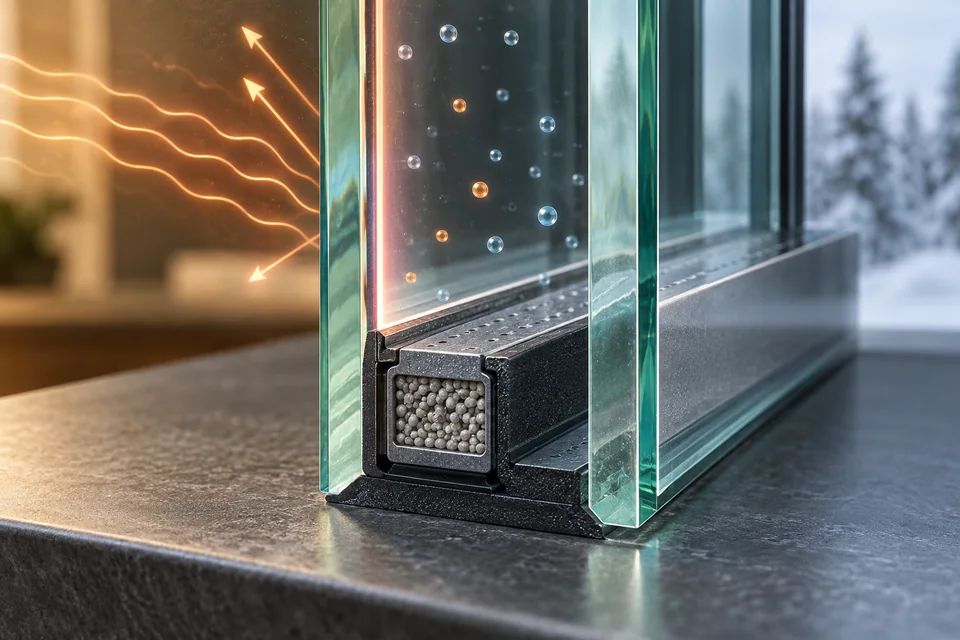
Indoor humidity has to fall as outdoor temperatures drop, or condensation forms on even very good windows. Colder regions need either more condensation margin from the glass, warm-edge spacers and insulated frames, or lower indoor humidity. Our sister portal CalgaryAtticRain.ca has a humidity target tool built for cold snaps.
05 /Why do wind and rain matter as much as cold?
Heat loss is only one kind of climate load. Windows also have to resist wind-driven rain and wind pressure, which vary more by exposure than by temperature. CMHC's 2005 consumer fact sheet, written under the older CSA A440 rating scheme, suggested higher minimum ratings for wind-driven rain on Haida Gwaii, Vancouver Island, the B.C. north coast, southeastern Alberta and southern Saskatchewan, the St. Lawrence Valley, the Gulf of St. Lawrence and much of Atlantic Canada, and higher wind-resistance ratings for places such as Alberta south of High River. It also advised higher ratings for tall buildings and exposed sites such as hilltops and bluffs.
Current products are rated under the North American Fenestration Standard and its Canadian Supplement, typically shown as a performance grade and a water penetration test pressure. The principle has not changed: in exposed places, ask the supplier to confirm that the rating suits your location and building height.
06 /What does this mean region by region?
- British Columbia coast: mild winters and long wet seasons. Water management, flashing and wind-driven rain ratings come first; good double glazing is often adequate, with triple for north rooms and comfort.
- Interior B.C. and the Prairies: cold, dry winters, strong sun, big temperature swings and, in southern Alberta, chinook winds and hail. Stable frames, low U-factors, hail-resistant exterior finishes and careful humidity control all matter. See window replacement in Alberta for Alberta cities, hail and local rules.
- Ontario and Quebec: cold winters and humid summers. Choose U-factor for winter, and lower solar gain on west glass to limit cooling loads.
- Atlantic Canada: wind-driven rain and salt air. Water resistance ratings, corrosion-resistant hardware and well-lapped flashing matter.
- The North: long, very cold winters. Very low U-factors, robust frames and planning for shipping and installation windows are essential.
The Window Replacement Planner uses national ranges and does not adjust for climate, so a triple-glazed choice in a cold region shows up as the planner's ×1.15 glazing multiplier rather than a regional price. For the glass decision itself, read triple-pane vs double-pane windows and low-e glass, gas fill and spacers; for the ratings, ENERGY STAR window ratings explained. You can request quotes and mention your location so installers can match the product to your climate.
FAQQuestions people ask
What ENERGY STAR zone is Calgary in?
Under the old version 4.0 specification, Calgary was listed at 5,000 heating degree-days in Zone 2. Since January 1, 2020, ENERGY STAR Canada uses one national requirement, so current products are not certified by zone.
What ENERGY STAR zone is Toronto in?
The version 4.0 appendix listed Toronto (City Hall) at 3,520 heating degree-days in Zone 2. Zones no longer apply under the current version 5.0 specification.
Do I need Zone 3 windows?
Not as such: zones were retired in 2020. The current national ENERGY STAR level is close to the old Zone 3 level. In very cold places, look for low certified U-factors and consider triple glazing.
What are heating degree-days?
A yearly total of how many degrees, and for how many days, the daily mean temperature falls below 18 °C. Higher totals mean colder climates and more heating.
Are triple pane windows necessary in Canada?
Not everywhere. They are most valuable in colder regions, on north- and east-facing walls and in humid homes. In mild coastal climates, good double glazing may be enough; compare certified ratings.
Does the climate zone change window prices?
The planner does not adjust by region. Real quotes vary by local labour and demand, and colder regions more often choose triple glazing, which the planner prices at 1.15 times double.
SOURCESSources and further reading
- Natural Resources Canada — ENERGY STAR Technical Specification, Version 4.0 (February 2015, PDF)
- Natural Resources Canada — Windows, doors and skylights: ENERGY STAR Canada technical specification
- Natural Resources Canada — Sample labels for windows, doors and skylights
- CMHC — About Your House: The ABC's of windows (2005, PDF)
- Natural Resources Canada — Key features and helpful tips: windows, doors and skylights