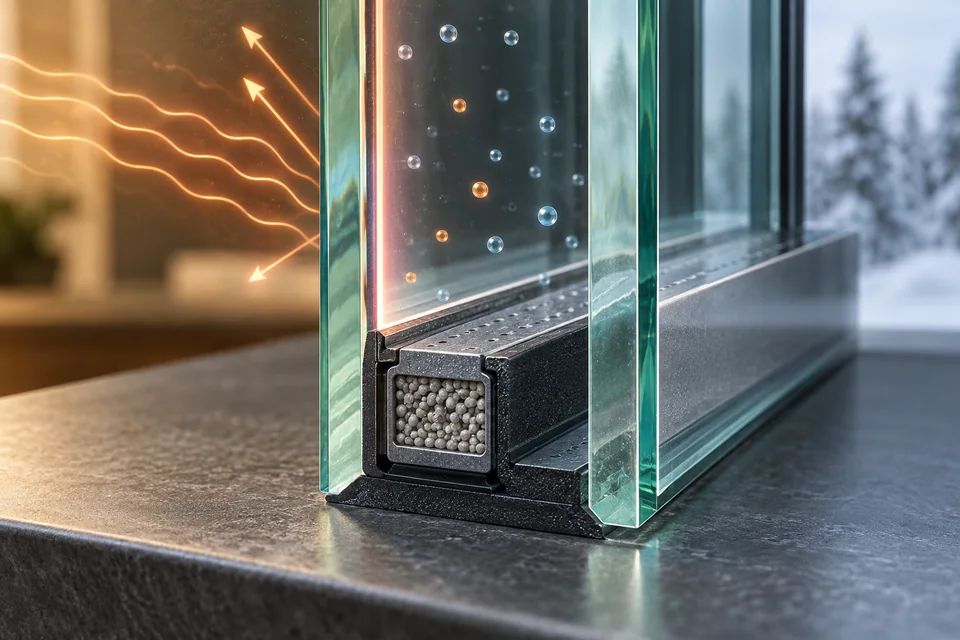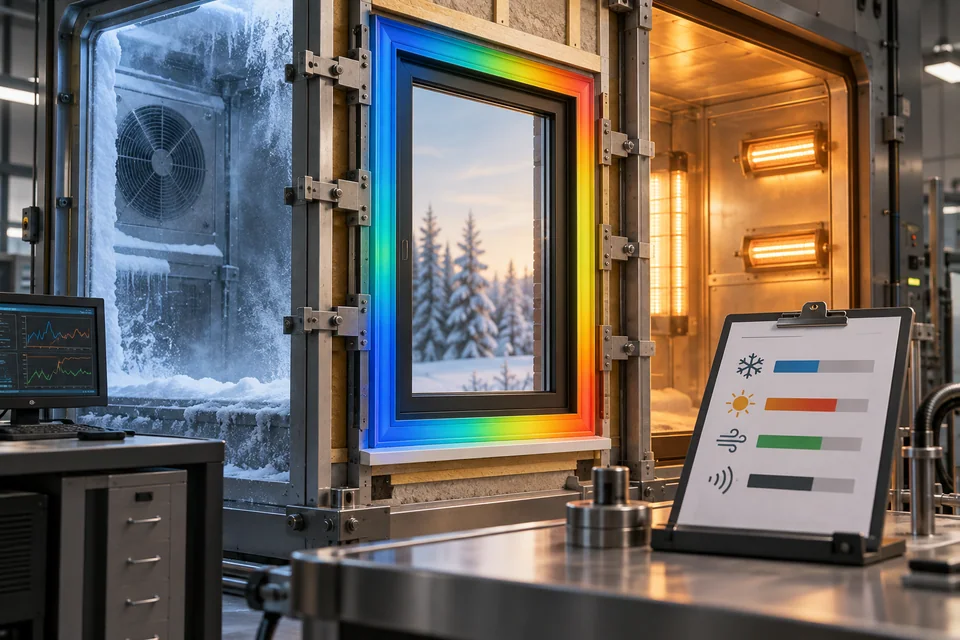
In Canada, ENERGY STAR windows are certified by Natural Resources Canada's program. Under the current specification (version 5.0, since January 2020), a window or door qualifies with a U-factor of 1.22 W/m²·K or lower, or an Energy Rating of 34 or higher, plus low air leakage. Lower U-factor means less heat loss; higher ER means a better winter energy balance; SHGC and VT describe sun heat and daylight.
- The current Canadian ENERGY STAR specification has one national requirement; the three climate zones belonged to the earlier version 4.0.
- Windows and doors qualify by U-factor (1.22 W/m²·K or lower) or by Energy Rating (34 or higher); skylights by U-factor (2.29 or lower). Air leakage must be 1.5 L/s/m² or less.
- U-factor measures heat loss (lower is better); ER combines heat loss, air leakage and solar gain (higher is better).
- SHGC and VT describe how much sun heat and daylight get through; choose them by orientation.
- Ratings are for a standard test size and do not include installation quality, which decides real-world comfort.
01 /What does ENERGY STAR mean on a window in Canada?
An ENERGY STAR certified window in Canada is a model that has been tested and certified to meet the energy performance levels in the ENERGY STAR technical specification issued by Natural Resources Canada (NRCan), which administers the ENERGY STAR name and symbol in Canada under an arrangement with the United States Environmental Protection Agency. Certified models are listed in NRCan's searchable product list and must be labelled according to NRCan's labelling requirements.
NRCan states that ENERGY STAR certified windows are about 20 percent more energy efficient than the average window, and that windows, doors and skylights can account for up to 25 percent of a home's energy loss. Those are national averages; your savings depend on your climate, your house and what you are replacing.
02 /What are the current ENERGY STAR requirements for windows?
The current specification is version 5.0, in effect since January 1, 2020, and it applies one set of requirements across Canada. NRCan's page for the specification was last modified in December 2024 when checked for this guide; specifications are revised from time to time, so confirm the current version before relying on these numbers.
| Product | Qualifies by | Requirement | Air leakage |
|---|---|---|---|
| Windows and doors | U-factor | 1.22 W/m²·K (0.21 Btu/h·ft²·°F) or lower | 1.5 L/s/m² or less, infiltration and exfiltration |
| Windows and doors | Energy Rating (ER) | 34 or higher | 1.5 L/s/m² or less, infiltration and exfiltration |
| Skylights | U-factor only | 2.29 W/m²·K (0.40 Btu/h·ft²·°F) or lower | 1.5 L/s/m² or less, infiltration and exfiltration |
The specification names the test standards it accepts: CSA A440.2 for the energy performance of windows, doors and skylights, the NFRC 100 and 200 procedures, and editions of the North American Fenestration Standard (AAMA/WDMA/CSA 101/I.S.2/A440). NRCan also runs an ENERGY STAR Most Efficient designation. For 2025 it required a U-factor of 1.05 W/m²·K or lower, or an ER of 40 or higher, and NRCan describes Most Efficient models as up to 55 percent more energy efficient than average models. That designation ran from January 1 to December 31, 2025, and when checked in September 2026 NRCan's Most Efficient pages still showed the 2025 criteria as the latest, so confirm the current level before relying on it.
03 /What happened to the ENERGY STAR climate zones?
The climate zones belonged to the previous specification, version 4.0 (February 2015). It divided Canada into three zones by heating degree-days, and a product could be certified for one, two or all three zones depending on its rating. Version 5.0 replaced the zones with a single national requirement roughly as strict as the old coldest zone.
| Zone | Heating degree-days | Minimum ER (ER path) | Maximum U-factor (U path, W/m²·K) |
|---|---|---|---|
| Zone 1 | Under 3,500 | 25 | 1.60 |
| Zone 2 | 3,500 to under 6,000 | 29 | 1.40 |
| Zone 3 | 6,000 or more | 34 | 1.20 |
Under version 4.0 the U-factor path also carried a minimum ER (16, 20 and 24 for zones 1 to 3), and qualification was cumulative: a Zone 3 product also qualified for Zones 1 and 2. You will still see zones on older labels, in NRCan's sample label gallery and in sales material. The climate zones page explains heating degree-days and what climate still means for window choice even without zones.
04 /What is a U-factor?
The U-factor is the rate of heat flow through the whole window per unit of area for each degree of temperature difference between inside and outside. In Canada it is usually given in W/m²·K; American literature uses Btu/h·ft²·°F. Divide the metric value by about 5.678 to convert. Lower is better.
- Whole-window vs centre-of-glass: the rating on a label is for the whole product, including frame and edge. Centre-of-glass numbers quoted in advertising look better and are not comparable.
- Operating type matters: a fixed window and a casement from the same line can have different U-factors, so ask for the rating of each type you are buying.
- R-value: whole-window R is roughly 1 divided by the imperial U-factor. At the ENERGY STAR limit of 0.21 that is about R-4.7.
05 /What is the Energy Rating (ER)?
The Energy Rating is a unitless Canadian index that balances heat loss, air leakage and potential passive solar gain in one number for a vertical window under standard heating-season conditions. Higher is better. The simplified equation published in NRCan's specification is ER = (57.76 × SHGC) − (21.90 × U-factor) − (1.97 × air leakage at 75 Pa) + 40.
Read the equation as a winter ledger: solar heat gain is a credit, while heat loss through the frame and glass and heat lost to air leakage are debits. A product can reach a high ER with a moderate U-factor if it lets in a lot of solar heat. That is useful on a south-facing wall, but a high-ER, high-solar-gain window facing west can overheat a room in summer. For north-facing windows, which see little direct sun, the U-factor is the more meaningful number.
06 /What are SHGC, VT and air leakage?
| Rating | What it measures | Range and direction | How to use it |
|---|---|---|---|
| SHGC (solar heat gain coefficient) | Share of the sun's heat striking the window that ends up inside | 0 to 1; higher lets in more sun heat | Higher on south walls in cold climates; lower on west walls that overheat |
| VT (visible transmittance) | Share of visible light that passes through | 0 to 1 or 0 to 100; higher is brighter | Keep high where daylight matters; low-e and extra panes reduce it slightly |
| Air leakage | Air passing through the product under a set pressure | L/s/m²; lower is tighter | ENERGY STAR requires 1.5 or less; fixed and casement windows tend to be tighter than sliders |
Condensation resistance can also appear in product literature. CSA's condensation test has used an index called the Temperature Factor, where a higher number means the room-side surfaces stay closer to room temperature; CMHC's 2005 fact sheet described 0 as outdoor temperature and 100 as room temperature. If your house runs humid in winter, ask for it.
07 /What other ratings appear on windows sold in Canada?
Energy ratings are separate from structural and weather performance. Windows sold in Canada are also rated for air leakage, resistance to water penetration and wind load. Older products and CMHC's 2005 consumer fact sheet used the CSA A440 'A-B-C' scheme: A1 to A3 for airtightness, B1 to B7 for water resistance and C1 to C5 for wind resistance. Current products are rated under the North American Fenestration Standard with its Canadian Supplement, which typically appears as a performance grade and a water penetration test pressure on the label.
These ratings matter more for tall walls, exposed coastal sites, hilltops and windy regions. Ask the supplier to confirm the product's performance grade suits your building's height and location; your local building department can tell you what is required.
08 /How do you check a window's ratings before you buy?
- Ask for the exact product series and each window type you are buying, not just the brand family.
- Look the model up in NRCan's searchable product list to confirm ENERGY STAR certification in Canada.
- Get the whole-window U-factor, ER, SHGC and VT for each type in writing, with the glass package they apply to.
- Confirm the glass package on the quote matches the rated one: number of panes, low-e coatings, gas fill and spacer.
- Keep the temporary label that comes on the window; NRCan advises keeping it for future reference, and a permanent certification mark should also appear on the product.
Ratings do not cover installation. NRCan warns that a poorly installed window, door or skylight can cause condensation, cold drafts or water leaks, and suggests, where possible, choosing a company in the Window Wise certification program; how to choose a window replacement company covers the other checks worth making. The installation, flashing and sealing guide explains what good installation includes. The Window Quote Checker counts 'ENERGY STAR certified' and 'low-e and gas fill specified' among its ten inclusions, and you can request quotes with your ratings checklist attached.
FAQQuestions people ask
What does ENERGY STAR mean on windows?
It means that model has been tested and certified to meet the energy performance levels in NRCan's ENERGY STAR specification for Canada and is listed on NRCan's searchable product list. It says nothing about the quality of the installation.
Are ENERGY STAR windows more expensive?
Often somewhat, because meeting the current level usually takes better glass, such as triple glazing or multiple low-e coatings, and tighter frames. In the Window Replacement Planner, triple glazing multiplies a unit's planning range by 1.15.
What is a good U-factor for windows in Canada?
The ENERGY STAR Canada U-factor path requires 1.22 W/m²·K or lower for windows and doors. NRCan's 2025 Most Efficient level was 1.05 or lower. Lower is better, so compare whole-window values for the exact types you are buying.
What is a good Energy Rating for a window?
An ER of 34 or higher qualifies a window or door for ENERGY STAR in Canada under version 5.0, and NRCan's 2025 Most Efficient level was 40 or higher. Because ER rewards solar gain, it is most meaningful for windows that receive winter sun.
Are ENERGY STAR windows the same in Canada and the United States?
No. Each country sets its own criteria for its climate. Look for certification under the Canadian specification and for the model on NRCan's searchable product list.
Do I still need to pick an ENERGY STAR zone?
Not under the current Canadian specification, which uses one national requirement. Zones appear on older labels and marketing from version 4.0. Climate still matters for choosing glass and features.
SOURCESSources and further reading
- Natural Resources Canada — Windows, doors and skylights: ENERGY STAR Canada technical specification
- Natural Resources Canada — ENERGY STAR Technical Specification, Version 4.0 (February 2015, PDF)
- Natural Resources Canada — ENERGY STAR certified windows, doors and skylights
- Natural Resources Canada — Sample labels for windows, doors and skylights
- CMHC — About Your House: The ABC's of windows (2005, PDF)