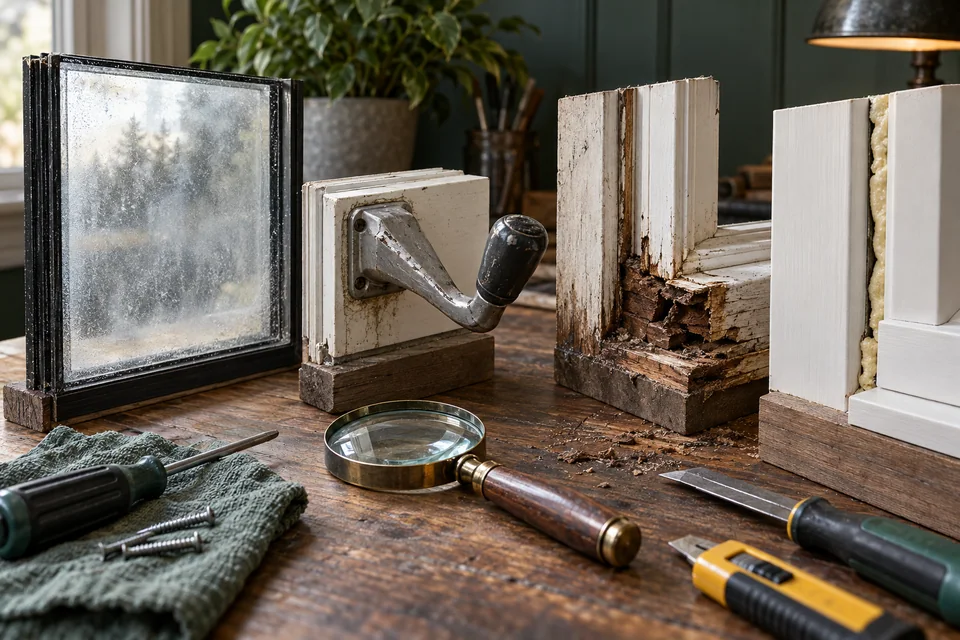
Window service begins by identifying the product and the failed component. Operators move a sash, hinges or balances support it, locks engage it, seals control air and water, and screens serve a separate insect-control role. Do not replace a part by appearance alone or compensate for misalignment by forcing the handle. Keep designed drainage and safety devices intact.
Canadian planning context. Technical examples from other regions are identified in the guide; approval and performance requirements must be checked for the actual building and jurisdiction. Original explanatory diagrams are not construction details.
- Record the window series, part identifiers, dimensions and handedness before ordering.
- An operator, hinge and lock perform different jobs even when one symptom involves all three.
- Weatherstripping must fit its channel and the sash motion without obstructing drainage.
- Screens are not fall protection or security barriers.
- Follow product-specific cleaning, lubrication and adjustment instructions.
01 /Build a component map before buying parts
A window has several systems that interact during one ordinary action. A crank operator drives a casement or awning sash; hinges support its motion; locking hardware pulls or holds the closed sash into position. A hung window may use cords and weights, spiral balances or another balance system. A slider relies on tracks and rollers or glides. A fixed window has no opening mechanism but still contains glazing supports, seals and frame drainage.
| Component | Primary role | Useful identification |
|---|---|---|
| Operator | Moves an opening sash | Casting number, arm configuration, handle and handedness |
| Hinge or balance | Supports the moving sash | Series, size, weight suitability and attachment |
| Lock and keeper | Engages the closed sash | Matching pair, mounting locations and operation |
| Weatherstrip or gasket | Forms a designed contact seal | Profile cross-section, material, length and channel |
| Screen assembly | Insect control | Frame, attachment, mesh, orientation and removal method |
Photograph the whole window and close-ups before removing anything. A part number on a casting may identify one component but not the compatible replacement kit. Include the window label and approximate manufacturing date when contacting the supplier. Similar screw holes or a familiar shape do not prove that a substitute carries the same sash safely.
02 /Diagnose motion separately from closing and locking
Observe whether the sash moves smoothly before it reaches the closed position. If it binds throughout travel, the cause may involve tracks, hinges, support or deformation. If it moves normally but will not latch, the problem may involve alignment, a keeper or seal contact. If the crank spins without movement, the operator or connection needs assessment. Describe these observations without deciding that the entire window has failed.
Stop if the sash is unsupported, damaged, unexpectedly dropping or difficult to control. Heavy glazing and loaded balance mechanisms make some repairs hazardous. Owners should not release a hinge, balance or sash attachment to discover what it does. Keep people away from an unstable opening and arrange qualified service.
A technician should distinguish component wear from an installation or frame problem. Replacing a crank cannot correct every racked frame, and increasing locking pressure can make a window harder to use. Ask for the underlying finding and the proposed repair, particularly if the same part has failed repeatedly. Preserve the removed component until the replacement operates correctly.
03 /Weatherstrip belongs to the motion and profile
Compression seals, pile or brush seals and flexible gasket profiles do not work in identical ways. A sliding sash needs a seal that permits its designed movement. A hinged sash may compress a gasket at closing. The profile height, flexibility, channel fit and corners all affect contact. A thicker self-adhesive strip can make an opening seem tighter while preventing the lock from engaging properly.
Order a compatible profile from the manufacturer or a specialist who can identify it. Take a clear cross-section photograph or retain a small sample only where removal is appropriate. Note whether the original has shrunk, torn, become brittle or pulled from its channel. Check adjacent corners rather than measuring only a straight section.
Do not bridge drainage slots with a replacement seal or create an unplanned dam in the sill. Sealant and weatherstrip are not interchangeable: one may form a stationary joint while the other accommodates opening and closing. After replacement, verify normal operation and even contact. The result should not require excessive force or defeat a safety release.
04 /Separate drainage openings from unwanted gaps
Some window frames contain deliberate drainage paths that let collected water reach the exterior. A small slot or opening can therefore be functional rather than a defect. Identify its purpose using the product’s manual. A photograph alone may not show which cavity it serves or whether a cap or baffle belongs over it.
Remove loose debris only by the permitted maintenance method. Avoid pressure-washing into joints, probing with sharp tools or filling a suspected weep with caulk. If water remains in a track, record the location and weather and ask for a drainage assessment. Repeated standing water can involve blockage, installation geometry or a component problem; clearing visible dirt is not proof that the whole drainage system works.
A draught may also originate at the sash, frame-to-wall joint or another nearby opening. Keep those locations separate in a service request. The repair-or-replace guide helps distinguish component service from a concealed wall-interface investigation.
05 /Use cleaning and lubrication instructions for the actual finish
Hardware finishes and lubricants vary. A product recommended for one operator may damage another gasket or attract grit in a track. Read the installed product’s care manual before adding oil, solvent or polish. If the hardware is concealed, ask which maintenance locations are owner-accessible and which require a service visit.
The Marvin Coastline owner manual illustrates why care is finish-specific: it distinguishes coated, brass, bronze and other hardware treatments. Treat it as guidance for those products, not a recipe for every manufacturer. Keep cleaning chemicals off adjacent weatherstrip and glazing unless the product instructions permit them.
Record recurring corrosion, loose fasteners or an operation change rather than covering them with lubricant. In a salty, dusty or industrial environment, ask the supplier whether the inspection interval or finish specification should differ. Maintenance reduces avoidable deterioration; it does not restore an unsuitable finish or prove that a weakened component remains safe.
06 /Treat screens as their own assembly
A screen includes more than mesh. The frame, spline, corners, springs, pins or clips need to fit the window. A screen that is slightly undersized may rattle or detach; an oversized one can deform during installation. Keep orientation labels and attachment details with the opening identifier, especially where similar windows use different screens.
The Marvin Elevate and Essential manual expressly warns that its insect screens are not safety devices. Do not rely on any ordinary insect screen to prevent a fall, stop a child or provide resistance to intrusion. Safety restrictors, guards and security systems require their own appropriate design and evidence.
Mesh choices can change visibility, insect exclusion, ventilation and cleaning. Ask for a sample if these qualities matter. A finer mesh may meet an insect concern while affecting light or airflow; a pet-resistant description does not make the frame a pet-containment barrier. Confirm how the screen is removed without leaning out of the opening or interfering with a required escape route.
07 /Locks, restrictors and safety devices need coordinated review
A lock secures a closed sash; an opening restrictor limits travel; a fall-prevention arrangement addresses a separate hazard. A device may affect more than one of these functions, but one label does not establish all of them. Check the manufacturer’s intended use, compatibility and release operation rather than attaching a universal device to every opening.
Where a window is required for emergency escape, an added device must be considered with that requirement. A keyed lock or a release that depends on a tool can change the use of the opening. Obtain the relevant local review and keep the agreed configuration in the window schedule. Do not remove an installed safety device simply to make cleaning easier.
Demonstrate the complete sequence to occupants. A technically compatible device can still be difficult to reach behind a counter or curtain. The accessible operation guide provides a way to specify user needs, while the permits and egress guide keeps jurisdictional requirements separate.
08 /Create a service record that survives the next owner
After a repair, note the date, opening identifier, part installed, supplier and reason for replacement. Photograph the new part and store the receipt and instructions. Record any adjustment performed and whether related seals, keepers or fasteners were renewed. “Window fixed” is too vague when the same symptom returns a year later.
At acceptance, check opening, closing, latch engagement, screen fit and the intended safety features. Compare the repaired window with the manufacturer’s operating instructions. Ask the technician to identify a recurrence that should prompt service instead of further owner adjustment. A repair warranty may cover the supplied component differently from labour or the original window.
Keep a small compatible spare only when the supplier recommends it; do not stock a random part based on appearance. Discontinued products sometimes require specialist fabrication or a broader repair. If compatible parts are unavailable, obtain a documented assessment of alternatives rather than improvising a support component. The goal is a serviceable, safely operating assembly, not merely a handle that turns.
FAQQuestions people ask
Can I replace a window operator with one that looks the same?
Appearance is insufficient. Confirm product series, part number, arm configuration, handedness, attachments and compatibility with the sash and supporting hardware.
Will thicker weatherstripping fix a draught?
Not necessarily. The correct profile must seal while permitting normal closing, locking and drainage. A draught at the wall joint or a distorted frame needs a different repair.
Does an insect screen prevent a child falling?
No. An ordinary insect screen is not a fall-prevention device. Obtain a suitable safety arrangement that is compatible with the window and applicable escape requirements.