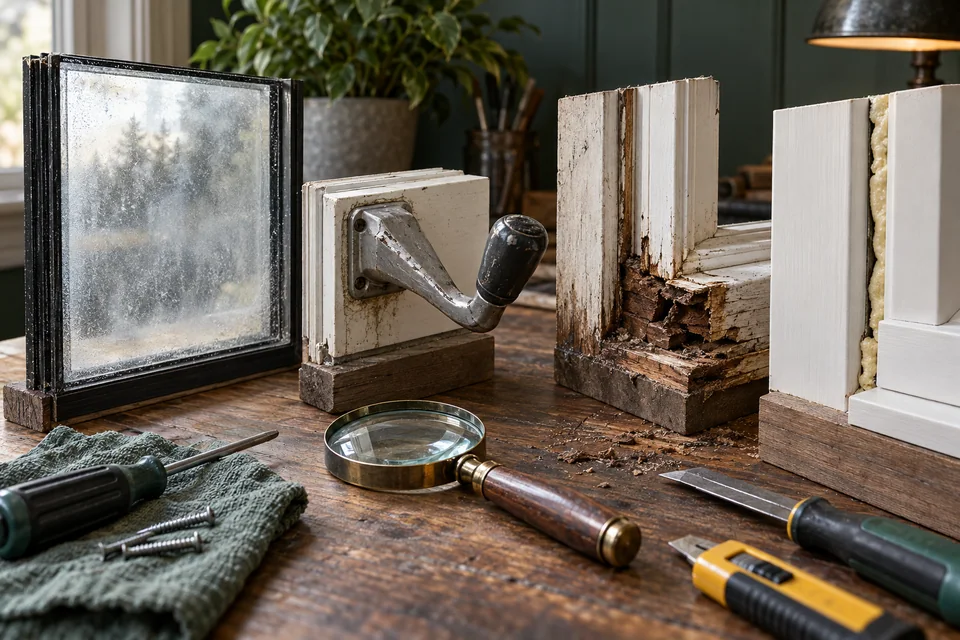
Window ownership is a sequence of inspection, permitted maintenance, component service and eventual renewal. Keep a numbered inventory, follow the actual product’s care instructions and record changes. Service life depends on materials, exposure, installation and maintenance; a universal replacement age is a poor substitute for condition. Plan reuse and recycling with confirmed local acceptance before removal.
Canadian planning context. Technical examples from other regions are identified in the guide; approval and performance requirements must be checked for the actual building and jurisdiction. Original explanatory diagrams are not construction details.
- Maintenance intervals should follow product instructions and actual exposure.
- Clean glazing, hardware, seals and finishes with compatible methods.
- A warranty period and a predicted service life are different concepts.
- Keep product identifiers and repair history so individual components can be serviced.
- An EPD is environmental information, not proof that a window is best for every project.
01 /Create an asset record at installation or now
Give each opening a stable identifier and connect it to the product, glass, hardware, location and documents. The homeowner inventory guide can help structure that record. A photograph of the finished room is useful, but labels, order numbers and drawings are often more useful when a glass unit or operator needs replacement.
Keep installation date separate from manufacturing date and from the date a particular component was replaced. A window installed many years ago may contain recently renewed glass and hardware. Recording only the building’s age can lead to an unnecessary whole-window replacement recommendation or an incorrect warranty inquiry.
Store the original invoice, warranty terms applicable to the purchase, installation instructions and care manual. Note who performed the work and who currently supports the product. If the original brand is discontinued, retain identifiers and physical samples where appropriate. Those details give a specialist a better chance of finding a compatible repair.
02 /Use an exposure-based inspection rhythm
There is no useful universal inspection interval for every window. The product’s manual, environment and previous findings should set the rhythm. A sheltered fixed window can have different needs from an operable coastal unit, a historic painted sash or a rooflight. Increase attention when a manufacturer requires it or when a recurring symptom justifies follow-up.
The Marvin Signature owner manual provides an example of a semi-annual inspection list and more frequent care in harsh environments. The JELD-WEN Canada care library separates product documents. Use the installed product’s current instructions rather than combining generic recommendations into a new recipe.
| System | Observe | Record or arrange |
|---|---|---|
| Operation | Change in motion, closing or latch engagement | Service before forcing a failing component |
| Seals and drainage | Tears, displacement, debris and persistent water | Compatible part or drainage assessment |
| Finish | Breakdown, exposed substrate or corrosion | Product-approved cleaning or finish repair |
| Glazing | Cracks, haze or moisture location | Safe photographs and specialist review |
| Wall interface | Staining, gaps and recurring wetness | Enclosure investigation where needed |
03 /Clean without damaging the system
Begin with the product’s instructions for glass, coatings, frame finish, hardware and screens. They may differ. A method acceptable on plain glass can scratch a coating or harm a seal. A chemical suitable for an aluminium finish may be unsuitable for another adjacent material. Keep the maintenance record linked to the exact product instead of posting one generic cleaning recipe for the whole house.
Avoid abrasive tools, improvised scraping and pressure-washing into joints unless the manufacturer specifically permits the method. Clean from a safe position. Tilting or removing a sash for access must follow the supplied instructions and account for its weight. Upper-storey and roof glazing may require professional access rather than a longer household ladder.
Record unusual deposits or repeated corrosion before cleaning. Their location can help explain exposure or another building problem. Clean surfaces make inspection easier, but an attractive finish after washing does not establish that a concealed joint or structural component is sound.
04 /Maintain finishes and timber deliberately
Wood, clad wood, vinyl, fibreglass and aluminium have different finish systems and repair options. Follow the actual coating and product instructions. “Maintenance free” should not be interpreted as no cleaning, inspection or component service. A material may resist one deterioration mechanism while its seals, hardware or installation still need attention.
Before repainting, identify preparation, compatible coatings and surfaces that must remain unpainted. Paint on a seal, track, glass edge or drainage opening can affect operation and water management. Historic coatings may need hazardous-material assessment before disturbance; see the restoration guide for the conservation planning context.
A finish failure is also a clue to exposure. Repeated peeling at one lower corner may involve water rather than simply a poor top coat. Address the confirmed cause before applying another finish. Where timber decay is suspected, obtain an assessment of its extent and the relevant repair rather than covering a soft area with filler and paint.
05 /Treat component service as part of ownership
An operator, gasket, balance, screen or insulating glass unit can sometimes be replaced without renewing the entire window. The decision depends on compatibility and the condition of the retained parts. Ask a technician to identify the failure and explain what the repair leaves untouched. A cheaper component is not necessarily the right answer when the frame or wall interface has also failed.
Record the replacement part, service date, supplier, labour and related findings. If the symptom recurs, that history reveals whether the same component failed or a different condition remains. Keep photographs and invoices together. A service record can also distinguish a later field modification from the original installation.
Check the actual warranty before commissioning work that alters the product. Warranty terms can vary by component, purchase date, transfer, installation and remedy. A long stated period does not establish that access, labour or every consequential repair is included. Request written confirmation of the claim and proposed remedy where applicable.
06 /Plan renewal by condition and objectives
Replacement may become appropriate when repairs cannot meet the property’s needs, compatible parts are unavailable, deterioration is extensive or several systems require renewal. Age is one clue, but it is not a universal expiry date. Compare the existing frame, glass, operation and installation against the intended comfort, access, appearance and enclosure outcomes.
Coordinate window work with cladding, roofing, interior renovation and energy improvements where useful. Exposing a perimeter during another project may create an opportunity to inspect and improve a wall connection. That opportunity should be evaluated, not turned into an automatic instruction to replace every sound window.
Use a phased plan for a large property. Urgent hazards and active moisture need prompt attention; a sound but less efficient unit may remain a later decision. Record priority, next inspection and an estimated scope rather than an unsupported universal cost or payback. Quotes can then be requested when the relevant project is ready.
07 /Ask what environmental claims actually describe
Manufacturers may publish environmental product declarations, recycled-content claims and other sustainability information. An EPD reports defined life-cycle information under a product category rule. It does not automatically identify the lowest-impact option for every climate, lifespan or installation. Comparison needs consistent units, scope, assumptions and product function.
FGIA’s sustainability resources explain the relationship between product category rules, life-cycle assessments and EPDs for fenestration. Use a current product-specific declaration where available. Check which stages are included and whether the document represents the actual product being quoted or a broader family.
A repair-versus-replacement decision also involves the condition and useful life of retained material, installation disturbance and operational performance. A low manufacturing impact and a low heating demand are different quantities. Where environmental performance is a major procurement criterion, have a qualified analyst compare scenarios instead of relying on a single green label.
08 /Confirm reuse and recycling before removal
A reuse recipient needs a product that suits its intended function, condition and applicable requirements. An old window’s dimensions and appearance are not enough to establish suitability for a new building. Keep labels and describe defects honestly. Do not donate damaged glass or hazardous materials as a way to avoid appropriate handling.
Recycling depends on local facilities and the assembly. Frames, flat glass, insulating units, laminated glass, coatings, sealants and hardware may require different handling. Confirm acceptance, preparation and transport with the actual facility before promising diversion. A municipal bottle-glass program should not be assumed to accept architectural glazing.
Ask the contractor to record where removed materials went and retain any receipts or diversion evidence agreed in the scope. A statement that something is recyclable describes a possibility, not proof that this project recycled it. For historic pieces, retain significant hardware or profile samples where the conservation plan calls for them.
09 /Hand over an understandable record
Keep the inventory short enough to use and detailed enough to support service. Each entry should link to photographs, product identity, instructions, dates and unresolved issues. Avoid burying the essential part number in a folder of unlabelled files. A simple shared index can be more useful than a complex database nobody maintains.
At sale, tenancy change or property-management handover, explain what is installed, how it operates and what needs attention. Include safety devices and any maintenance that differs from the rest of the building. Mark warranties as documents to assess, not automatic transferable promises.
Review the record after every repair. A window’s serviceable life is supported by compatible maintenance and informed decisions. The best ownership plan keeps material in use where it remains suitable, identifies problems early and prepares renewal without inventing an expiry date for every opening.
FAQQuestions people ask
How many years should every window last?
There is no reliable universal age for every assembly. Product, exposure, installation, maintenance and individual component condition affect the decision to repair or renew.
Does an EPD prove a window is environmentally best?
No. It reports defined life-cycle information. A fair comparison needs compatible scope, units, assumptions and function, alongside the actual project’s performance and service life.
Can old window glass go in household glass recycling?
Do not assume so. Confirm architectural-glass acceptance and preparation with the local facility before removal or transport.