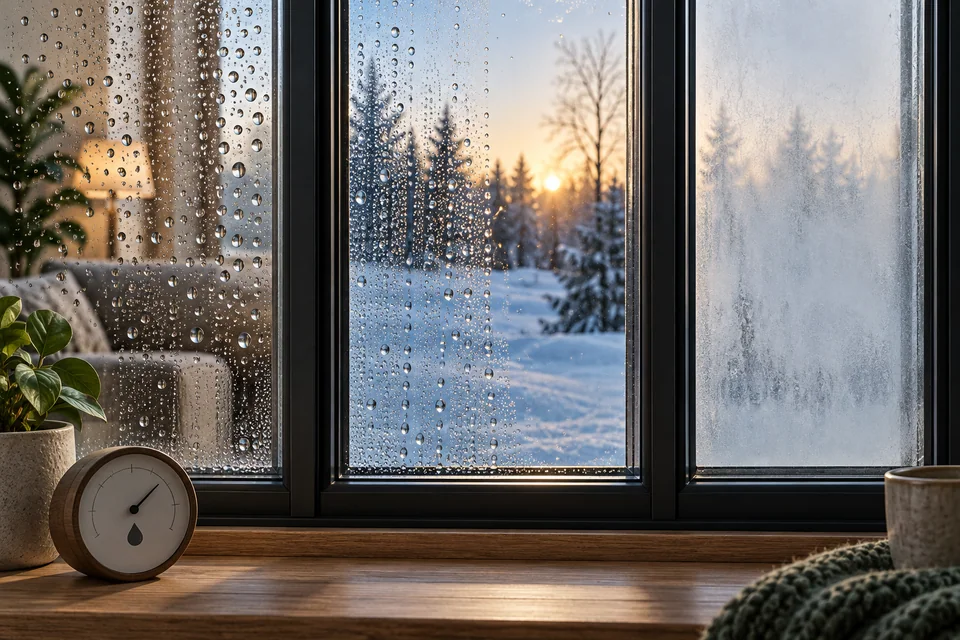
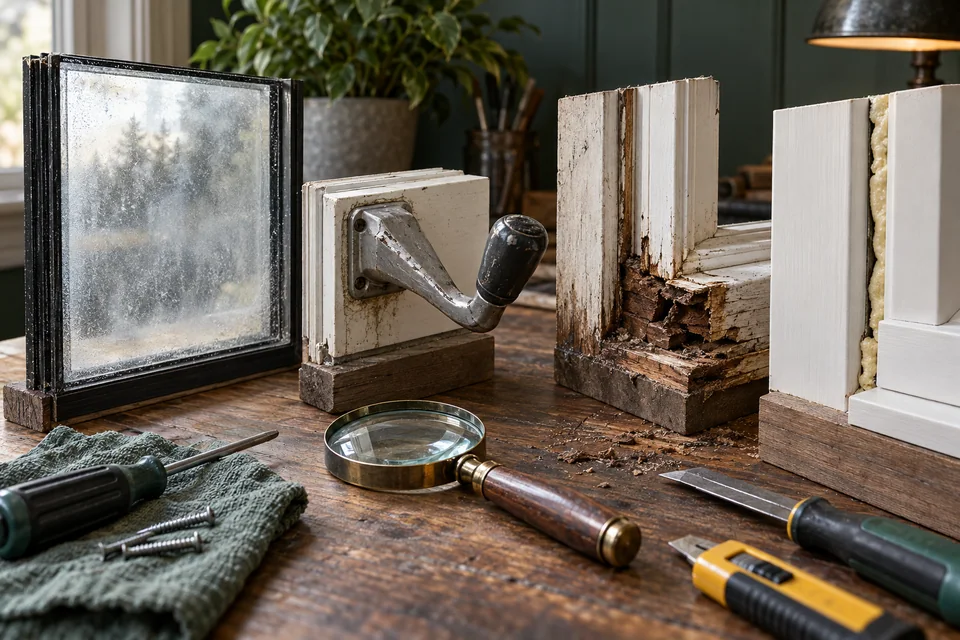
Identify the location, timing and conditions of a symptom before selecting a repair. Surface moisture, moisture inside a sealed glass unit, water at the wall joint, damaged glass and difficult operation have different causes and repair scopes. Record observations from a safe position, preserve product identifiers and have unstable glass, active wall moisture or unsupported sashes assessed professionally.
Canadian planning context. Technical examples from other regions are identified in the guide; approval and performance requirements must be checked for the actual building and jurisdiction. Original explanatory diagrams are not construction details.
- Determine which glass surface is wet before calling a sealed unit failed.
- A window stain can originate from the wall or roof as well as the window.
- Crack appearance alone cannot reliably establish cause or responsibility.
- A component repair and a whole-window replacement solve different problems.
- Keep before-repair evidence and warranty documents; do not modify a unit to diagnose it.
01 /Start with an observation record
Describe what happened without naming a cause too early. “Water on the room-side lower edge during a cold morning” is more useful than “bad windows.” Record the opening identifier, date, room use, weather and recent changes. Photograph the whole window, the symptom and nearby wall or ceiling from safe positions. Include a scale where appropriate without touching damaged glass.
Note whether the symptom occurs on one unit, several units on an elevation or throughout the building. A single failed component and a shared enclosure or indoor-moisture issue can produce different patterns. Ask whether the window was recently repaired, painted, cleaned, adjusted or covered with a blind or film. These facts inform investigation; they do not prove the last contractor caused the problem.
Separate immediate hazards from ordinary service. Broken overhead glass, an unstable sash, a suspected falling-glass hazard or active water near electrical equipment needs an appropriate make-safe response. Keep people clear and obtain qualified help. This guide supports observation and a repair brief; it is not an instruction to dismantle or load-test a damaged assembly.
02 /Locate moisture before judging the glass seal
| Observation | Possible scope | Next useful evidence |
|---|---|---|
| Room-side glass can be wiped dry | Surface condensation, room moisture or cold surface | Indoor conditions, blinds and timing |
| Exterior glass is wet | Outdoor surface condensation or weather | Safe confirmation of surface and time of day |
| Moisture appears inaccessible between sealed panes | Insulating-glass unit assessment | Photographs, unit identifiers and warranty |
| Water at trim or wall finish | Window perimeter or wider enclosure investigation | Rain, wind, roof and wall observations |
| Water in a frame track | Product drainage and installation review | Drainage manual, debris and persistence |
NRCan’s condensation guidance distinguishes surface condensation from condensation between panes after a sealed unit’s seal breaks. Andersen’s exterior-condensation explanation also shows why outdoor dew can occur without a glass-unit failure. Neither observation should be confused with rain entering the wall.
Confirm the surface only where it is safely accessible. Do not lean outside to wipe a high pane. A technician can assess an inaccessible location. Note that dirt, residues, coatings and reflections can resemble haze in photographs. A distant image is useful evidence, but it may not distinguish surface film from moisture inside an insulating unit.
03 /Investigate insulating-glass symptoms as a component problem
If moisture is confirmed inside a sealed insulating glass unit, ask the manufacturer or glass specialist to assess the unit and its warranty. Replacing the glass unit can be a separate option where the sash and frame remain suitable. The replacement needs the correct dimensions, pane construction, coating, spacer, safety requirements and support, not simply a clear pane that fits.
Record the glass markings, spacer text, window label and original order where available. These identifiers can help match a replacement and establish which warranty applies. Some warranties address the supplied unit differently from installation labour, access or surrounding damage. Obtain the actual remedy in writing before authorising removal.
Drilling or venting a sealed unit is not a diagnostic test that preserves its original construction. Do not treat a service described as defogging as equivalent to a newly specified insulating unit. Ask what the service changes, what performance is claimed and what evidence supports that claim. A temporarily clearer view does not establish the original thermal or sealing performance.
04 /Cracked glass needs investigation, not an instant verdict
Glass can break for several reasons, including impact, edge damage, thermal stress, support or loading conditions and other product-specific factors. A crack pattern can guide a specialist, but a photograph alone should not be used to assign cause, warranty responsibility or workmanship failure. Preserve the circumstances and evidence before the pane is removed.
Keep people and pets away from damaged glass. Do not press on a cracked pane or attempt to measure its thickness at a broken edge. Temporary protection, removal and replacement should be planned by someone equipped for the glass and location. An upper-storey or overhead unit changes the consequence of falling pieces and the safe access method.
Ask the replacement supplier to review the glass construction and support as well as the size. A pane that broke in service should not automatically be copied without considering relevant findings. Changing glass type can affect weight, appearance, hardware and certification; the broader assembly may need review before ordering.
05 /Optical effects do not all mean structural failure
Reflections can look wavy, glass may show colour differences, and some effects change with viewing angle, light or polarised sunglasses. Insulating glass can also deflect as pressure conditions change. These observations deserve documentation, but they are not all equivalent to a crack or failed seal. Ask the supplier to assess the appearance under the relevant product criteria.
Describe whether the effect is in transmission, reflection or both, and whether it changes through the day. Compare panes from the same position and light conditions. Do not rely on an edited photograph or a close-up from an unusual angle alone. Keep the original image and note how it was taken.
The FGIA frequently asked questions point to different glass and insulating-glass standards for evaluating blemishes and performance. That distinction matters: an appearance criterion and a structural requirement answer different questions. Obtain the applicable criterion and the manufacturer’s assessment rather than inventing an acceptable scratch size online.
06 /Follow leaks beyond the visible stain
A water mark below the sill does not prove the sill joint is the entry point. Water can travel from roofing, cladding, a higher opening or a concealed connection. Record precipitation and wind direction where known, the first visible wet location and how it develops. A recurring leak during driven rain may behave differently from indoor condensation during cold weather.
An enclosure investigation may include controlled testing or planned opening-up. Agree on the scope, protection of finishes and how findings are documented. Random hose spraying or sealing every visible seam can confuse the evidence and interfere with drainage. A repair should address a reviewed water path, not merely cover the closest joint.
Once a cause is established, obtain the repair detail and responsibility for surrounding materials. Wet insulation, damaged framing or stained finishes may need separate work. A new bead of sealant is not evidence that concealed materials are dry or that the original defect has been resolved.
07 /Operation failures can involve more than hardware
A stiff sash can involve debris, a worn component, damaged seals, a distorted frame or misalignment. Record whether the difficulty occurs while moving, at closing or during locking. An unsupported sash or failing balance requires qualified service rather than repeated force. The component guide explains the roles of operators, hinges, balances and locks.
Ask the technician to assess the frame and installation before replacing the same operator again. If the unit is out of square or support is inadequate, adjustment may offer only a temporary change. Conversely, a compatible new component may solve a local problem without disturbing the wall. The repair brief should say what was found and why the chosen scope addresses it.
Test the complete sequence after repair with the supplied screen, restrictor and locks in place. A window that opens but will not securely close is not an accepted result. Where accessibility or emergency operation is required, recheck those functions too. Keep the old and new part identifiers with the service record.
08 /Close the investigation with evidence and a clear next step
A useful service report separates observed facts, likely causes, confirmed findings and unresolved questions. It identifies the product, location, access limits and proposed repair. If the cause remains uncertain, the next step should be explicit: additional inspection, monitoring, controlled testing or opening-up. Uncertainty is a reason to gather evidence, not a reason to replace everything automatically.
Compare repair options on the same scope. Glass-only replacement, hardware service, perimeter reconstruction and full-frame replacement have different disruption and residual risks. Ask what each option leaves untouched. Keep before-repair photographs, removed-part information and warranty correspondence until the claim or repair is settled.
After repair, observe the opening under relevant conditions and record the result. No visible leak on a dry day does not establish performance during the weather that previously produced it. A formal test or inspection should state its method and limits. The completed record gives the owner and next service provider a much stronger starting point than “it seemed fine when we left.”
FAQQuestions people ask
Does exterior condensation prove my new windows failed?
No. Exterior surface dew can occur under suitable weather conditions without a sealed-unit failure. Confirm the moisture location safely and distinguish it from rain entry.
Can a crack pattern tell me who caused the break?
It can inform a specialist’s assessment but should not establish cause or responsibility from a photograph alone. Preserve the circumstances and product evidence.
Does a fogged insulating unit require replacing the whole window?
Not always. A glass-unit replacement may be possible if the sash, frame, support and broader performance remain suitable. Obtain the correct replacement specification and warranty assessment.