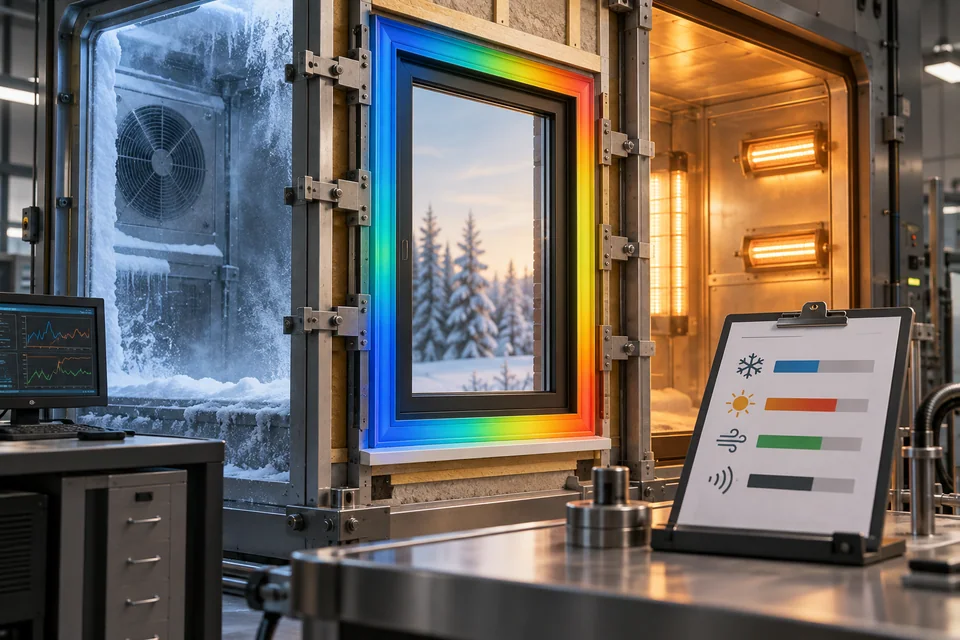
A window loses heat through glass, its edge, frame and installation joint. U-factor describes the rated rate of heat transfer per area and temperature difference; lower is better. R-value is its reciprocal only when the units and assembly scope match. Certified whole-window data is a useful comparison, while an installed-window assessment also needs the wall junction, air leakage, solar gains and actual climate.
Canadian planning context. Technical examples from other regions are identified in the guide; approval and performance requirements must be checked for the actual building and jurisdiction. Original explanatory diagrams are not construction details.
- Compare the same rating method, units, operating type and scope before comparing numbers.
- SI resistance is RSI = 1/U(SI); imperial R = 5.678/U(SI), approximately.
- The illustrative equation Q = U × A × ΔT estimates steady heat flow, not a household bill.
- A small window has more frame and glass-edge length per square metre than a large one.
- An energy label does not rate the installer’s wall junction or predict condensation at every cold spot.
Window Rating Lab
01 /Follow four separate heat paths
Imagine a window on a dark winter evening, with the room warmer than outdoors. Energy flows from the warm side toward the cold side. In the solid glass and frame it moves by conduction. At the exposed surfaces, moving air exchanges heat by convection. Across the sealed gap, gas conducts heat and can circulate; the two facing glass surfaces also exchange long-wave radiation. The low-e coating targets that radiative exchange. A gas fill, spacer and thermally improved frame address different parts of the same assembly. No single ingredient represents the whole window.
Air leaking through a latch, gasket or the frame-to-wall joint is a separate transport path: warm air carries energy and moisture out, or cold air enters. Do not add an arbitrary leakage allowance to a labelled U-factor and call the result a certified rating. Air leakage depends on pressure, direction, opening condition and workmanship. A draught can dominate your experience even when the glass itself insulates well. Conversely, a cold pane can feel uncomfortable without an air leak, because your body exchanges radiant heat with it and room air cools as it travels down the surface.
| Part | Useful question | What the answer does not establish |
|---|---|---|
| Glazing | What is the verified glass and whole-window U-factor? | Quality of the frame-to-wall air seal |
| Low-e coating | Which product and which surfaces? | The solar gain of every possible assembly |
| Gas space | Which fill, gap and certified glass make-up? | A fixed lifetime gas concentration |
| Edge spacer | What is the spacer and edge thermal performance? | A condensation-free perimeter |
| Frame and sash | What thermal breaks or insulating chambers form the tested design? | Performance of a different size or operator |
| Installation joint | How are air, water and thermal continuity detailed? | Factory product certification |
02 /Read U-factor with its units attached
U-factor is thermal transmittance. In SI units, W/m²·K says how many watts cross each square metre for each kelvin of temperature difference under the rating conditions. A temperature difference of 1 K equals a difference of 1°C; an absolute temperature of 1 K is another matter. The common imperial unit is Btu/h·ft²·°F. Both express the same physical quantity on different scales. A value of 0.20 printed without units is an incomplete specification.
For conversion, multiply an imperial U-factor by approximately 5.678 to get W/m²·K. Divide the SI value by 5.678 to get the imperial value. For example, 0.20 Btu/h·ft²·°F is approximately 1.136 W/m²·K. A supplier’s 0.8 W/m²·K number is therefore lower than that example, rather than four times worse. Unit conversion alone does not make values comparable: European and North American calculations can use different boundary conditions and reference sizes. Ask for ratings under the same recognised method when making a purchasing comparison.
03 /Convert resistance without turning RSI into imperial R
Resistance is the reciprocal of transmittance for the same complete assembly and conditions. RSI, in m²·K/W, equals 1 divided by the SI U-factor. Imperial R, in h·ft²·°F/Btu, equals 1 divided by the imperial U-factor. Therefore imperial R is approximately 5.678 divided by the SI U-factor. The distinction matters when a sales document gives a centre-glass RSI but describes it simply as an R-value.
| U-factor, W/m²·K | U-factor, Btu/h·ft²·°F | RSI, m²·K/W | Imperial R |
|---|---|---|---|
| 2.00 | 0.352 | 0.50 | 2.84 |
| 1.40 | 0.247 | 0.71 | 4.06 |
| 1.00 | 0.176 | 1.00 | 5.68 |
| 0.80 | 0.141 | 1.25 | 7.10 |
Do not add individual R-values for the glass, frame and spacer as though they were layers stacked across every part of the opening. Those paths are partly in parallel: heat can cross the frame while it also crosses the glass. The whole assembly needs an area-weighted calculation with edge effects. That is one reason a highly insulating centre-glass result can coexist with a materially worse whole-window result. Use the complete product’s certified number for a simple shopping comparison.
04 /Work an illustrative heat-flow example
The steady-state estimate Q = U × A × ΔT gives heat flow in watts when U is in W/m²·K, area A is in m² and the temperature difference ΔT is in kelvins or degrees Celsius. Consider an assumed 2 m² window at U = 1.4, a 21°C room and −9°C outside. The temperature difference is 30°C, so Q is 1.4 × 2 × 30 = 84 W. An otherwise identical assumed U = 0.8 window gives 48 W, a difference of 36 W under those specific conditions.
If those assumed conditions lasted for 10 hours, the difference would be 0.36 kWh of thermal energy. That result is not 0.36 kWh of purchased electricity in every home: a heat pump, furnace or district system converts purchased energy into delivered heat differently. Neither figure includes sun, changing weather, air leakage, installation thermal bridges or heating-system controls. The example is useful for seeing why area and temperature difference matter, and for checking a claim’s arithmetic. It does not predict quote-specific savings.
Notice another implication: halving U halves this conductive heat-flow term for the same area and temperature difference, but it does not halve the building’s total energy use. Walls, roof, foundation, ventilation, hot water and appliances remain. A modest glass upgrade can still improve comfort at a favourite chair even when the annual utility savings are small. Separate comfort value, durability value and energy value when deciding whether replacement is worthwhile.
05 /Distinguish centre-glass, whole-window and installed values
Centre-glass data represents the glazing away from its edges. Whole-window data also accounts for the frame, sash and the glazing-edge effect under the chosen rating method. Installed performance adds the consequences of the connection to the building: frame position, supporting materials, insulation return and the perimeter thermal bridge. These are three useful scopes, but none should quietly substitute for another.
NFRC’s residential programme verifies whole-product energy ratings. Canadian ENERGY STAR certification refers to the defined model and qualifying configuration, rather than every assembly with a similar product name. Keep the model code, operator, glass option and applicable rating record with the quote. A fixed picture window, casement and slider in the same brand’s range can have different energy results. Changing a decorative grille, spacer, glazing or frame can change which configuration the record represents.
- Ask whether a number is glass-only, complete factory product, or installed assembly.
- Ask whether the rating is for a reference size or your scheduled size.
- Ask whether the rating record includes the exact operator and glass package.
- Keep a separate installation detail for the head, sill and jamb, including insulation and drainage.
06 /Why size, frame fraction and mullions change the result
A narrow bathroom window devotes a greater proportion of its opening to frame than a large picture window. It also has more glass-edge length per unit of area. A row of small units with several mullions is therefore different from a single large pane, even if all use the same centre-glass package. Thermal performance is one consideration; structural limits, ventilation, handling, sightlines and safe replacement access may justify subdivisions.
Request the window schedule rather than using one favourable brochure number for every opening. List outside dimensions, clear glass dimensions, opening type, glass code and the rating record. If a project-specific calculation is available, identify the calculation method and whether installation losses are included. Do not assume that enlarging a window makes the room more energy efficient simply because its area-weighted U-factor improves. The larger opening may still lose more total heat because Q contains the area term.
07 /Why a cold feeling is not always an air leak
Radiant exchange depends on the surfaces you face. Sitting close to a cold, large window can feel uncomfortable even when the thermostat reads a comfortable air temperature. A cold pane also cools nearby air, producing a downward flow that people often call a draught. A leaky gasket produces a different problem, although the two can occur together. Describing the symptom precisely helps an installer avoid treating every comfort complaint with extra caulk.
Observe whether the sensation varies with wind, whether it occurs only near the glass, and whether latching the sash changes it. Surface-temperature investigation, pressure testing and inspection of the perimeter seal answer different questions. An infrared image of glass needs care because reflections and emissivity settings can distort the apparent temperature. A handheld camera is an observation tool, not proof that a product violates its label. The surface-temperature and dew-point lab explains the moisture connection.
08 /Build a defensible specification
For a straightforward renovation, put a maximum whole-window U-factor with units and the rating method in the scope, then specify the exact products that satisfy it. Pair that with separate requirements for solar gain, daylight, air leakage, water resistance, structural suitability and installation. A lower U-factor is generally beneficial for reducing heat transmission, but it is not a complete measure of annual energy balance or room usability.
For a deep retrofit, ask the designer to model the complete opening, including the installed perimeter, orientation and shading. Keep substitutions subject to review: a lower glass-only number may conceal a worse frame or different solar gain. Finally, retain the labels, model list and installation photographs at handover. These records are more useful for future service than a verbal statement that the home has high-performance windows.
- Product schedule: exact manufacturer, series, operator, size and glass make-up.
- Energy evidence: whole-window U-factor, method, units and matching model record.
- Room design: SHGC, visible transmittance and planned shading.
- Installation: continuity of insulation, air seal, water control and sill drainage.
- Acceptance: correct delivered product, usable operation and documented exceptions.
FAQQuestions people ask
Is U-value the same as U-factor?
In common window discussions both mean thermal transmittance. Check the units, calculation method and scope; the names alone do not establish that two values are comparable.
Can I compare a European Ug number with a Canadian window label?
Ug is glazing-only. Compare complete-window values under a consistent rating method, and assess the installed junction separately. Unit conversion does not remove method differences.
Does a lower U-factor establish my bill savings?
It reduces rated heat transmission for the same area and conditions. Total bills also depend on climate, solar gains, leakage, heating equipment, occupancy and other building loads.
Do I multiply U-factor by the glass area or the opening area?
Use the area that matches the rating scope. A whole-window U-factor goes with the complete rated product area; a glass-only number cannot silently stand in for that product.
SOURCESSources and further reading
- NFRC — Residential product certification; North American whole-product energy ratings
- Natural Resources Canada — Canadian ENERGY STAR fenestration specification, version 5.0; Canadian certification scope
- U.S. Department of Energy — Purchasing energy-efficient residential windows; U.S. purchasing guidance
- DOE Building Science Education — High-performance window systems: glass; conventional glazing, gas and low-e overview, not Canadian code