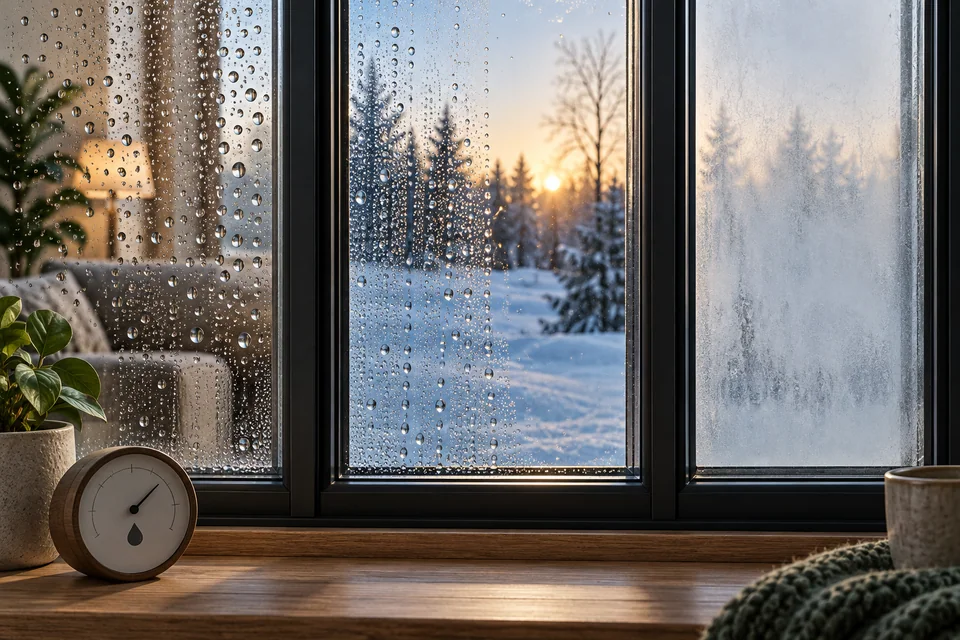
Condensation becomes possible when a surface is at or below the dew point of the air touching it. Enter indoor temperature, relative humidity and a measured glass temperature to explore that relationship. The lab calculates a liquid-water dew point and an illustrative surface margin; it does not predict every edge temperature, calculate frost point, set a healthy humidity target or certify a window.
Canadian planning context. Technical examples from other regions are identified in the guide; approval and performance requirements must be checked for the actual building and jurisdiction. Original explanatory diagrams are not construction details.
- Measure the coldest relevant frame or glass-edge location as well as the centre.
- Dew point depends on the room’s moisture content, while surface temperature depends on the product, installation and conditions.
- A positive calculated margin has uncertainty: sensor error and colder unmeasured spots matter.
- Below 0°C this liquid-water calculation is not a frost-point calculation.
- Room-side, between-pane and exterior moisture have different causes.
Window Moisture Lab
01 /Start with the location of the water
Water on the room-facing pane is usually a surface-temperature and indoor-moisture problem. Water or haze inside a sealed glass unit points to a different investigation, involving the unit’s seals and moisture control. Moisture on the outside may appear when the exterior pane cools below the outdoor air’s dew point, including radiative cooling on a clear night. Wiping a reachable surface safely can help establish which side is affected; do not dismantle a sealed unit to diagnose it.
The location changes what to ask next. Indoor droplets concentrated at the bottom edge suggest checking that cold zone and its local air circulation. A cloud between panes that persists when accessible surfaces are dry deserves a glazing-service assessment. Rainwater appearing around trim calls for an investigation of water entry, flashing and drainage rather than an automatic diagnosis of condensation. A sill can receive both rain leakage and condensate, so a useful report records weather, timing and where water first appears.
02 /What dew point means
Relative humidity describes how the actual water-vapour pressure compares with saturation at the air’s current temperature. If air with the same moisture content cools, its relative humidity rises because the saturation pressure falls. The dew point is the temperature at which it would reach saturation with respect to liquid water. A cold window can reach that condition locally even when the middle of the room seems comfortable.
This is why one humidity percentage cannot predict dry windows in every season or building. A better-insulated glazing centre may remain warm while a frame corner or conductive spacer is colder. A curtain can alter air movement and surface conditions. Outdoor weather, wind and indoor heat distribution change the available margin. The lab lets you compare moisture with a measured surface; it deliberately does not infer that surface temperature from a U-factor or a product label.
03 /The lab’s formula and its limits
The calculation uses the liquid-water saturation-vapour-pressure relation documented in the U.S. National Weather Service’s humidity and dew-point worksheet: es(T) = 6.112 × exp[17.67T/(T + 243.5)], with temperature in °C and pressure in hPa. With known relative humidity, actual vapour pressure is e = RH/100 × es(Troom). Inverting the same relation gives Td = 243.5 × ln(e/6.112) / [17.67 − ln(e/6.112)].
The surface margin is measured surface temperature minus calculated dew point. The illustrative relative-humidity threshold at that surface is 100 × es(Tsurface)/es(Troom). That threshold describes saturation in the simplified calculation; it is not a recommended indoor humidity setting. Values outside the everyday physical interpretation require care, and a surface warmer than the room does not create a meaningful condensation limit below 100% room RH.
The lab accepts room temperatures from 5 to 35°C, relative humidity from 5 to 95%, and measured surface temperatures from −20 to 35°C. These are interface limits, not a validation range established for every building condition. The formula is an approximation over liquid water. When a surface or calculated dew point is below freezing, frost formation involves saturation over ice and may differ. The tool flags this limitation rather than relabelling its result as frost point. For specialist design, use validated psychrometric methods and applicable surface-temperature models.
04 /Interpret a worked example
For an assumed room at 21°C and 40% RH, the formula gives a liquid-water dew point of about 6.9°C. An assumed measured surface at 12°C has approximately 5.1°C of margin in this calculation. A surface at 5°C is below that calculated dew point. These are illustrative inputs, not readings from a particular home. No product suitability or humidity prescription follows from them.
| Lab result | Useful interpretation | Next question |
|---|---|---|
| Surface above dew point | That input pair is below liquid-water saturation at the entered surface | Could the edge or frame corner be colder? |
| Surface near dew point | Small changes or measurement error could alter the result | How accurate and representative are the readings? |
| Surface below dew point | Liquid-water condensation is possible under those assumptions | Is the water actually on that surface, and how persistent is it? |
| Sub-zero surface or dew point | Liquid-water result has frost limitations | Does a specialist ice/frost assessment matter? |
| No visible moisture | The observation alone does not establish a safe assembly | Is moisture occurring elsewhere or within the wall? |
Repeat observations during conditions that resemble the complaint. A warm afternoon reading cannot explain a cold-night problem. Equally, a brief cold-snap occurrence is different from persistent wetting that damages finishes. Record duration and consequences as well as the calculation. The goal is to assemble evidence for a practical response, not to win an argument with a single number.
05 /Measure carefully, especially on reflective glass
Place the room humidity sensor where it represents the air near the room, away from direct sun, supply jets and moisture sources. Allow it to stabilise according to its instructions. Low-cost sensors can disagree; treat small differences cautiously and record the device and timing. Indoor moisture can vary between rooms, and a closed bedroom occupied overnight may not match a hallway reading.
Glass is a challenging surface for infrared temperature measurement because it reflects thermal radiation and its apparent emissivity may differ from the camera setting. A bright thermal image can represent a reflected heat source rather than the pane itself. A suitable contact surface probe used without damaging finishes can be useful; specialist thermography follows controlled procedures. Do not use an infrared photo alone to assert an exact condensation threshold or a failed product.
- Record indoor air temperature and RH at the same time as surface temperature.
- Record outdoor temperature, wind exposure, sun and blind position.
- Measure the glazing centre, lower edge and relevant frame corners safely.
- Note whether the sash was fully latched and nearby supply air was operating.
- Keep uncertainty beside the result, especially when the calculated margin is small.
06 /Why the glazing edge and room furnishings matter
The glazing edge joins glass to a spacer and frame, creating different heat paths from those at the centre. The surrounding frame may include metal reinforcement, hardware or local geometric bridges. Consequently, a favourable centre measurement does not prove the lowest surface is equally warm. Small windows have more edge length relative to glass area, which makes edge quality especially relevant.
A tight blind, deep sill, furniture or heavy curtain can separate the window from room air and change heat exchange. This does not mean curtains are always harmful or should be removed as a universal instruction. Observe whether the condition changes with ordinary open and closed positions, then discuss the room’s heating and ventilation arrangement. Moisture management should not rely on exposing occupants to an unnecessarily cold room or keeping a defective window permanently open in winter.
07 /Separate moisture control from product improvement
Lowering indoor moisture and warming a cold surface act on different sides of the dew-point relationship. Ventilation, source control and heating arrangements can affect indoor moisture or local temperature. A better glazing system, warmer edge and improved installation can raise surface temperatures. A failed seal or rainwater leak needs its own repair. An effective response begins with identifying which mechanism actually occurs.
Natural Resources Canada’s retrofit guidance warns that replacement can reduce incidental leakage, so the home’s moisture balance may change. Health Canada treats ventilation as part of managing indoor pollutants and moisture. Do not read the lab’s theoretical saturation threshold as a health target, a required ventilation rate or permission to alter mechanical equipment. Where moisture persists, mould develops or the home cannot maintain acceptable conditions, involve an appropriate building or ventilation professional and address the cause.
08 /Ratings do not predict every installed surface condition
NFRC recognises Condensation Resistance and the newer Condensation Index methods. They are comparative rating methods under defined conditions, not predictions that every installed unit will remain dry at every humidity. Do not compare two differently named condensation ratings as though their scales were identical. Ask which method, record and configuration the quoted number represents.
Whole-window energy ratings are also not surface-temperature maps. A product can have a low U-factor yet include a local cold detail; installation can add another cold junction. For a high-humidity room, commercial façade or deep retrofit, a designer may need detailed temperature assessment of the frame, edge and wall junction. Provide the intended indoor and outdoor conditions and ask for the lowest relevant surface temperature, rather than accepting a general promise of no condensation.
09 /Turn observations into a useful service brief
Give the supplier a dated location sketch, photographs of accessible surfaces, indoor and outdoor readings, weather and the lab’s assumptions. Include when the unit was installed, its model and glass make-up if known, how it operates and whether the problem follows rain or cold. Distinguish damage or persistent standing water from occasional mist that clears. Keep the original symptoms separate from the explanation you suspect.
The condensation guide helps sort common cases, while insulating-glass edge seals explains the sealed unit. If the complaint is a cold seat rather than visible moisture, use the heat-flow lab and describe comfort separately. A good brief lets the right person assess glazing service, water leakage, heating, ventilation or the installation joint without assuming the answer in advance.
FAQQuestions people ask
Does the lab calculate my window’s surface temperature?
No. It uses the surface temperature you enter. U-factor alone cannot establish the coldest point on your installed frame or glazing edge.
Is the displayed RH threshold a humidity target?
No. It is the mathematical saturation threshold for the entered surface and room temperature under a liquid-water approximation. Health, ventilation, building durability and sensor accuracy need separate consideration.
Why does the lab warn below freezing?
The formula describes saturation over liquid water. Saturation over ice and frost point differ; a sub-zero dew-point result is not automatically a frost-point prediction.
Can I use it to diagnose fog between panes?
It can help explain surface moisture but does not test a sealed unit. Persistent between-pane fog needs a glazing-service investigation.
SOURCESSources and further reading
- NOAA / U.S. National Weather Service — Saturation vapour pressure and dew-point equations over liquid water
- NFRC — Condensation Index; rating methods and limitations
- NRC — Window condensation and surface temperature, Canadian Building Digest; historical building-science reference
- Natural Resources Canada — Keeping the Heat In, section 8; Canadian retrofit guidance
- Health Canada — Ventilation and the indoor environment; Canadian moisture and air-quality context