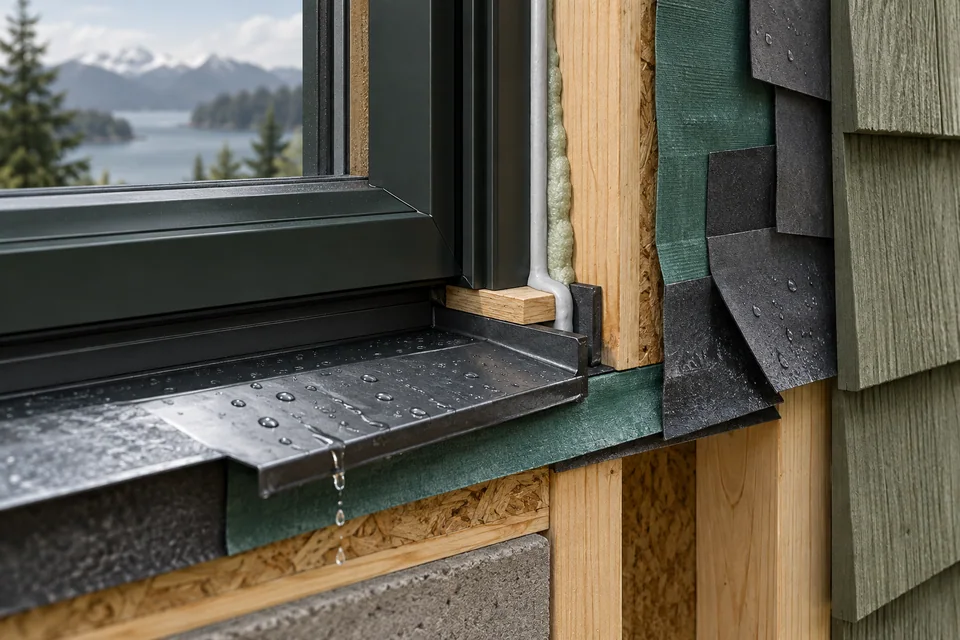
A good window installation manages four things: water, air, heat and support. Water is handled by a sloped sill pan and shingle-lapped flashing so anything that gets past the sealant drains out. Air is stopped by a continuous interior seal. Heat is slowed by insulating the gap with low-expansion foam or backer rod and sealant. Shims and fasteners hold the frame square without bending it.
- Exterior sealant is the last and weakest line of defence; flashing and drainage do the real work against rain.
- Every layer should be shingle-lapped: upper materials overlap lower ones so water always runs outward.
- Seal the interior side for air first; NRCan warns that sealing the exterior first can trap moist air in the wall.
- Use low-expansion foam made for windows, or backer rod and sealant; high-expansion foam can bow the frame.
- Never seal weep holes or the drainage gap at the bottom of capping; water that gets in has to get out.
01 /What does a proper window installation include?
A proper installation does four jobs at once. It keeps rain out of the wall, stops air leaking around the frame, insulates the gap between window and wall, and supports the window so it stays square and operates freely. The window itself can be excellent and still leak, draught or fog along its edges if any of the four is skipped.
| Job | Main components | What failure looks like |
|---|---|---|
| Water | Sill pan, jamb and head flashing, drip cap, drainage, exterior sealant | Stains below the window, soft sills, water on the floor after wind-driven rain |
| Air | Continuous interior air seal between frame and wall air barrier | Draughts around the trim, frost or condensation at the frame edge |
| Heat | Low-expansion foam or backer rod and sealant in the shim space | Cold trim, condensation around the casing |
| Support | Shims at load points, installation screws or clips, level, plumb and square | Binding sashes, misaligned locks, cracked sealant, bowed jambs |
NRCan puts it plainly: a poorly installed window, door or skylight may cause condensation, cold drafts or even allow water to leak into your home. It also suggests, where possible, choosing a company that is in the Window Wise certification program. Whether or not an installer holds a certification, ask them to describe each of the four jobs in writing.
02 /How should a replacement window be flashed?
A replacement window should be flashed so any water that gets past the outer seal is collected and drained back outside. Assume some water will get in; wind-driven rain, failed sealant and condensation inside the frame all put water where it should not be. The flashing sequence works from the bottom up so every upper layer laps over the one below it, like shingles.
- Sill pan
A pre-formed pan or a membrane pan across the rough sill, turned up at the back (a back dam) and at the ends, and lapped out over the wall's weather barrier or cladding. It should slope slightly to the outside.
- Set the window
The window sits on shims placed on the pan, not on a continuous bead that would block drainage at the front.
- Jamb flashing
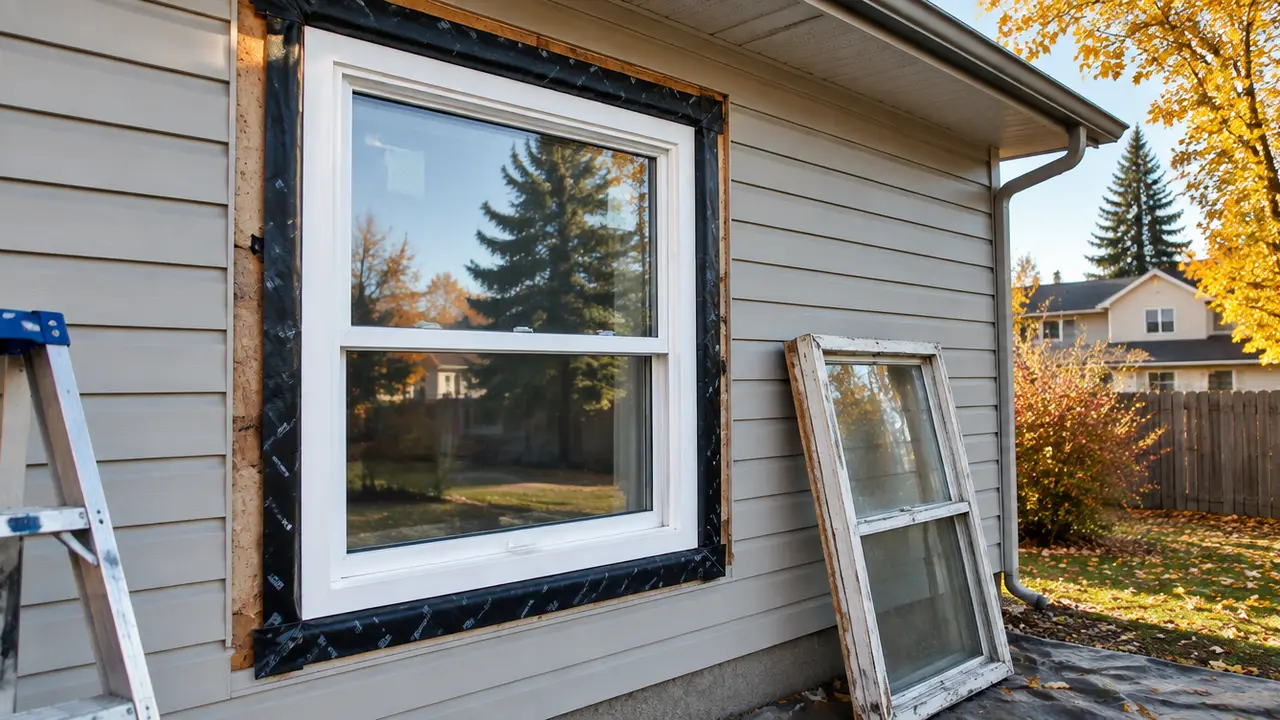
Flashing tape or membrane at the sides, lapped over the sill pan's upturned ends so water runs down and out.
- Head flashing and drip cap
A metal drip cap or head flashing sheds water away from the top of the frame, with the weather barrier above lapped over it.
- Outer seal
Sealant with backer rod closes the joint between frame or trim and cladding, leaving the bottom drainage path open.
NRCan's retrofit guide describes the principle for the air barrier: top flashing goes underneath the barrier above the window, while side and bottom flashings go on top of it. Whatever the wall, the test is the same: follow a drop of water down the wall and check that at every joint it is carried outward, never inward.
Full-frame replacement allows this whole sequence. With an insert, the old frame stays and its original flashing, if any, is what protects the opening; the installer can only add a sill angle, seal the new unit to the old frame and cap the outside. That is why an opening with a leak history needs full-frame replacement.
03 /Spray foam or backer rod and sealant: what goes in the gap?
The gap between the window frame and the rough opening, or the old frame, needs insulation and an air seal. The two usual approaches are low-expansion foam designed for windows and doors, or backer rod with sealant. Both work when used correctly; the right choice depends on the gap width and whether the gap is part of the air barrier.
NRCan's guide gives practical sizes: if the gap is small, about 6 mm (1/4 in.) or less, insulating the gap and then caulking may be enough; larger gaps may need either backer rod with caulking or low-expansion foam. High-expansion general-purpose foam is the wrong product for windows. It can push the jambs inward, making sashes bind and locks misalign, and the damage often shows up weeks later.
04 /Why seal the inside first?
Seal the interior air barrier before the exterior, because warm, moist indoor air is what causes damage inside walls in a Canadian winter. NRCan's guidance is that exterior caulking should be done only after interior sealing is complete; if the exterior is caulked first, it can trap warm, moist air in the wall, which over time can damage it. The interior seal connects the window frame to the wall's air barrier with sealant, foam or air-barrier tape hidden behind the casing.
NRCan calls exterior caulking the last and weakest defence against rain. Its job is to shed most water and look tidy. It is not a substitute for flashing, and it should never close off the drainage paths at the bottom of the frame, the sill or the aluminum capping.
05 /How should shims and fasteners be used?
Shims carry the window's weight and hold it square; fasteners keep it from moving. The window should rest on shims under the jambs and under any mullions, with more shims at hinge and lock points on casements and at meeting rails on sliders, and fastened where the manufacturer's instructions say, usually through the frame at the shim locations or with installation clips or brackets.
- Check level at the sill, plumb at the jambs and square by measuring both diagonals; they should match.
- Drive screws snug, not tight. An over-driven screw pulls the jamb inward and distorts the sash gap.
- Shims should not block the sill pan's drainage toward the outside.
- After fastening, operate every sash and lock before foam and trim go on. Adjust now, not after the casing hides the shims.
Installation instructions from the window manufacturer are part of the warranty. Ask whether the crew installs to the manufacturer's instructions, and keep a copy with your paperwork.
06 /Which tapes and sealants should be used?
Flashing tapes, membranes and sealants must be compatible with each other, with the window frame, and with the wall's weather barrier. Some sealants do not bond to certain membranes or can soften them, and many tapes have minimum application temperatures or need a primer in cold weather. Winter installations are common in Canada, so ask what the crew uses below those temperature limits.
For the exterior joint, installers generally use a high-performance sealant rated for movement and exterior exposure, sized with backer rod so the sealant bonds only to the two surfaces it joins. Interior trim is sealed with a paintable interior sealant; NRCan cautions against using exterior caulking indoors.
07 /What should you check after installation?
- Every sash opens, closes and locks smoothly; casements close evenly against the weatherstrip.
- The frame is square: reveals and sash gaps look even all round.
- No draught at the trim on a windy day; a smoke pencil or incense stick held near the casing shows air movement.
- Exterior sealant is continuous at the sides and top, and the bottom drainage paths are open.
- Capping is bent cleanly, lapped so upper pieces overlap lower ones, and does not trap water at the sill.
- Interior trim is complete and any gaps are sealed.
- Labels and certification stickers are kept, and you have the product series, warranty registration and installation warranty in writing.
- Debris, glass and old sashes have been removed as quoted.
If you are comparing installers, ask each one to describe their sill pan, flashing, gap insulation and interior air seal in the quote. The Window Quote Checker counts 'installation method specified' and 'exterior capping and flashing' among its inclusions. Brick and stucco walls add their own details, covered in the brick and stucco guide. How to choose a window replacement company covers vetting a crew, and DIY window replacement sets out which jobs a homeowner can realistically take on. When you are ready, request quotes.
FAQQuestions people ask
What is the best sealant for window installation?
For exterior joints, a high-performance sealant rated for exterior use and joint movement, compatible with the frame, cladding and any membranes, installed over backer rod. Indoors, a paintable interior sealant. Ask the installer which products they use and whether they meet the window maker's instructions.
Should windows be installed with spray foam?
Low-expansion foam made for windows and doors is a common, good way to insulate the gap. General-purpose high-expansion foam can bow the frame and should not be used. Backer rod and sealant is an alternative for narrow gaps.
What is a sill pan?
A tray of pre-formed material or flashing membrane across the bottom of the rough opening, turned up at the back and ends, that catches any water getting past the window and drains it to the outside.
What is window installation tape used for?
Flashing tape seals and laps the window's edges or nailing fin to the wall's weather barrier, forming part of the drainage system. It must be compatible with the barrier and sealants and applied within its temperature limits.
Why is water coming in at the bottom of my new window?
Common causes are blocked weep holes, a missing or reverse-lapped sill pan, sealant that has closed off drainage, or water entering above the window and running down behind the cladding. Report it to the installer promptly under the installation warranty.