Replacement windows cut outside noise mainly by being airtight and through the design of the glass, not the pane count. National Research Council Canada tests found factory-sealed triple glazing performs about the same as double glazing unless the gaps are very wide. A wider airspace, panes of unequal thickness, laminated glass, a solid frame and a sealed installation do more, especially against low-pitched traffic and aircraft noise.
- Air leaks let in more noise than glass does, so a tight sash and a sealed frame-to-wall joint come first.
- In NRC testing, factory-sealed triple glazing gave essentially the same sound transmission class (STC) as double glazing of similar total thickness.
- Doubling the space between two panes raised the STC by roughly 3 points in NRC's data, and panes about twice as thick as each other worked best.
- STC underrates low-pitched noise; the OITC rating (ASTM E1332) is built from aircraft, road and rail sound, so ask for it when traffic is the problem.
- Laminated glass damps vibration, but NRC notes the benefit can drop sharply at typical Canadian winter temperatures.
01 /Do new windows actually reduce outside noise?
Yes, often noticeably, when the windows being replaced leak air or have thin, closely spaced glass. The improvement comes from three places, roughly in this order: closing the air paths around the sash and frame, adding mass and separation to the glass, and keeping the frame itself from vibrating. Sound follows any route air can take, so a gap that costs you very little heat can undo an expensive glass upgrade.
The clearest plain-language account of how glass handles sound is still the National Research Council's Canadian Building Digest 240, “Sound Transmission Through Windows”, written by J.D. Quirt and published in February 1988. NRC now keeps it as a historical reference, so read its numbers as laboratory findings rather than ratings for today's products. The physics it describes has not changed, and it explains why several popular assumptions about quiet windows are wrong.
| Factor | What NRC found | What to ask for |
|---|---|---|
| Air leakage at the sash | An openable window with good weatherstripping usually rates 3 to 5 STC points below the same window sealed shut | Compression-seal operation (casement, awning) or fixed glass on the noisy side |
| Space between panes | STC rose about 3 points for each doubling of the air space in double glazing | The widest glass spacing the product allows, or a separate interior pane |
| Pane thickness | Unequal panes resonate at different frequencies; a thickness ratio of about 2 worked best | Asymmetric glass, with one pane clearly thicker than the other |
| Laminated glass | Much higher transmission loss than solid glass above its coincidence frequency, thanks to damping | A laminated pane, with test data for that exact configuration |
| Third pane in a standard sealed unit | Essentially the same STC as double glazing unless both gaps are much wider than usual | Choose triple glazing for heat and condensation, not for noise alone |
| Frame | Some lightweight metal frames tested lower, apparently from vibration carried by the frame | Stiff, well-sealed frames; avoid flimsy profiles on the noisy wall |
02 /What do STC and OITC ratings mean?
The sound transmission class (STC) is a single-number rating calculated from laboratory measurements of how much sound a product blocks in a series of frequency bands, by fitting a standard reference curve to the results. Higher is better. It was designed around sources such as the human voice, and NRC's digest points out that it does not properly rate insulation against sounds with strong low-frequency content. Road traffic and aircraft are exactly that kind of sound.
The Outdoor-Indoor Transmission Class (OITC) was built for this problem. ASTM E1332 calculates it from transmission loss data in one-third octave bands from 80 to 4,000 Hz, weighted against a reference spectrum averaged from three transportation sources: aircraft take-off, road traffic and a diesel locomotive passing by. ASTM describes it as a more reliable way to rank facade elements against such noise than the STC classification, while noting it is not meant for sources whose sound is very different, such as some industrial noise.
03 /Are triple-pane windows better for noise than double-pane?
Usually only slightly. NRC compared a double-glazed and a triple-glazed window of similar total thickness and found their transmission loss curves almost identical above about 250 Hz, with the triple unit roughly 3 dB better only below that point, which is what the extra glass mass alone would predict. Both earned the same STC. The digest adds that factory-sealed glazing in a single sash normally has 15 mm or less of total air space, and unless both gaps in a triple unit are much wider than that, its STC stays very close to a double unit's.
The reason is an effect called mass-air-mass resonance. The air trapped between two panes behaves like a spring and passes vibration from one sheet of glass to the other. In typical factory-sealed double glazing that resonance falls between about 200 and 400 Hz, which is where much of the energy in aircraft and road noise sits. A wider air space and heavier glass push the resonance lower, out of the way. Dividing the same overall thickness into two narrower gaps, as a triple unit of similar size does, does not.
None of this makes triple glazing a poor buy. NRCan lists better exterior noise reduction among its benefits, the extra mass helps a little with low rumble, and it earns its place on heat loss and condensation, as the triple-pane vs double-pane guide explains. It simply means that if noise is your main complaint, a third pane should not be the only change you pay for.
04 /Does laminated glass make windows quieter?
It can, particularly against mid- and high-pitched sound. Every sheet of glass has a coincidence frequency at which bending waves travel through it easily and its sound blocking dips sharply. NRC notes that this frequency falls as glass gets thicker: near 5 kHz for 2 mm glass, but in the 500 Hz band for 18 mm glass. That is why simply buying thicker single panes raises the STC very little.
Laminated glass bonds two or more sheets with thin plastic interlayers. Above the coincidence frequency, NRC found it can block far more sound than solid glass of the same weight, apparently because the interlayer dissipates vibration. There is a Canadian catch: the damping depends on temperature, and the digest warns that at typical Canadian winter temperatures the gain from lamination may be drastically reduced. It still helps for much of the year, and it adds security and extra ultraviolet protection, but treat laboratory figures as best-case numbers for a cold January.
Laminated glass also changes weight, cost and sometimes the certified energy rating of the window. Ask for the rated U-factor of the configuration that includes it, as described in low-e glass, gas fill and spacers.
05 /Which window types and installation details matter most for noise?
The tighter the window closes, the quieter it is. CMHC's consumer fact sheet on window ratings notes that fixed windows tend to earn better airtightness ratings than operable ones, and that sliders tend to be leakier than casements. NRC adds a warning that matters when you pay for acoustic glass: the higher a window's sealed rating, the more a given leak costs it, so an expensive glass package in a loose slider can disappoint.
- Noisy elevation: favour fixed glass where you do not need ventilation, and casements or awnings that clamp against their weatherstrip where you do. Bedrooms still need a window that opens for escape; see permits and egress.
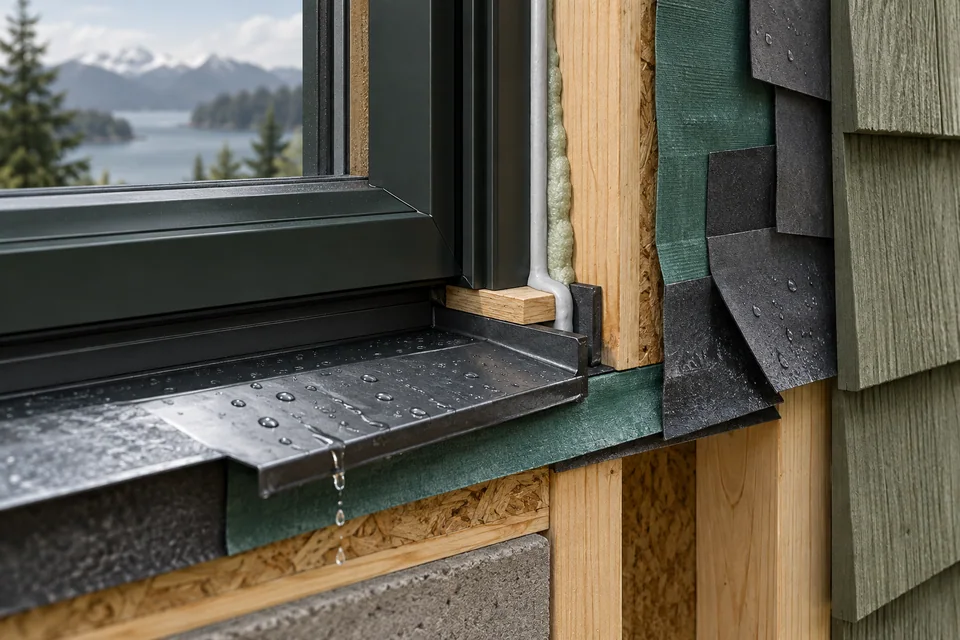
- Frame-to-wall joint: the gap between the new frame and the rough opening should be fully insulated and sealed on the room side, then sealed outside. See installation, flashing and sealing.
- Locks and keepers: adjusted so the sash compresses its weatherstrip evenly all the way round.
- Insert or full-frame: an insert seals to the old frame, so any leak between that old frame and the wall stays in place. Where noise matters and the trim is coming off anyway, full-frame work lets the installer seal the whole opening; see insert vs full-frame replacement.
06 /What else reduces outside noise besides new windows?
A second, separate layer of glass with a wide gap is the classic acoustic fix, and it follows directly from NRC's finding that the air space drives performance. NRCan's retrofit guide describes interior storm windows fastened to the window frame, including rigid acrylic sheets held by magnetic seals, and notes they should be sealed tightly so warm air does not reach the gap. Such a panel usually sits much farther from the prime window than the panes of a factory-sealed unit sit from each other. Keep expectations modest for thin sheets: NRC found transparent plastic blocks about as much sound as glass of the same weight, and 8 mm of plastic behaved roughly like 4 mm of glass.
- Other openings: exterior doors, mail slots, through-wall vents and air conditioners often leak more sound than a good window.
- Room planning: bedrooms on the quiet side of the house gain more than any product.
- Walls and roofs: lightweight walls and roofs also carry sound, which is why a single new window rarely silences a room facing a highway.
Traffic noise is a long-standing housing issue in Canada. CMHC's 1981 revised publication “Road and rail noise: effects on housing”, prepared with NRC's Division of Building Research, observed that surface traffic noise causes more neighbourhood dissatisfaction than aircraft noise because it reaches most urban areas rather than a few zones. If you live beside a highway, rail line or flight path, raise it early with installers, and check whether your municipality has noise studies or policies for the area.
07 /How should you ask for quieter windows in a quote?
- Say which rooms are affected and what the noise is: traffic, rail, aircraft, a busy neighbour or wind.
- Ask for tested STC and OITC values for the whole window, in the operating type and glass configuration being quoted.
- Ask what acoustic options the product line offers: a wider glass spacing, one thicker pane, a laminated pane, and what each does to weight, U-factor and price.
- On the noisiest wall, ask whether fixed or compression-seal windows can replace sliders without losing required ventilation or egress.
- Ask how the frame-to-wall gap will be insulated and air sealed, and get the method in writing.
The site's Window Replacement Planner has no acoustic option, so laminated or asymmetric glass will appear only in real quotes. Line those quotes up in the Window Quote Checker, which turns missing items into questions, and read is window replacement worth it for how quiet ranks against the other benefits. When you request quotes, mention the noise problem so installers can offer the right glass.
FAQQuestions people ask
Do triple pane windows block traffic noise better than double pane?
Only a little in most standard units. NRC testing found a triple unit about 3 dB better below roughly 250 Hz and essentially identical above it, with the same STC. Air space width, unequal pane thickness, lamination and airtightness matter more.
What does OITC mean on a window?
Outdoor-Indoor Transmission Class, a rating defined by ASTM E1332. It weights sound blocking against a blend of aircraft, road and rail noise from 80 to 4,000 Hz, so it suits traffic problems better than STC. Higher is better.
Is laminated glass worth it for a noisy street?
It often helps, especially with mid- and high-pitched sound, and adds security and UV protection. NRC notes its damping weakens in cold winter temperatures, so pair it with a wider air space and an airtight window rather than relying on it alone.
Why can I still hear traffic after getting new windows?
Common reasons are air leaks at the sash or around the frame, sliders on the noisy side, closely spaced panes that resonate with low-pitched rumble, and other paths such as doors, vents and thin walls. Check the installation seal first.
Are casement windows quieter than sliders?
Usually. Casements and awnings pull the sash tight against compression weatherstrip, while sliders tend to leak more air, and CMHC's fact sheet notes sliders tend to be leakier than casements. Fixed glass is tighter still.
Can I make my existing windows quieter without replacing them?
Often. Renew weatherstrip, adjust locks, seal the trim joint, and consider a tightly sealed interior storm panel, which adds a wide air space. Those steps can help noticeably when the existing windows are sound.
SOURCESSources and further reading
- National Research Council Canada — Canadian Building Digest 240: Sound transmission through windows (J.D. Quirt, 1988)
- ASTM International — E1332: Standard Classification for Rating Outdoor-Indoor Sound Attenuation
- CMHC — Road and rail noise: effects on housing (1981, Government of Canada Publications)
- CMHC — About Your House: The ABC's of windows (2005, PDF)
- Natural Resources Canada — Keeping the Heat In, Chapter 8: Upgrading windows and doors (PDF)