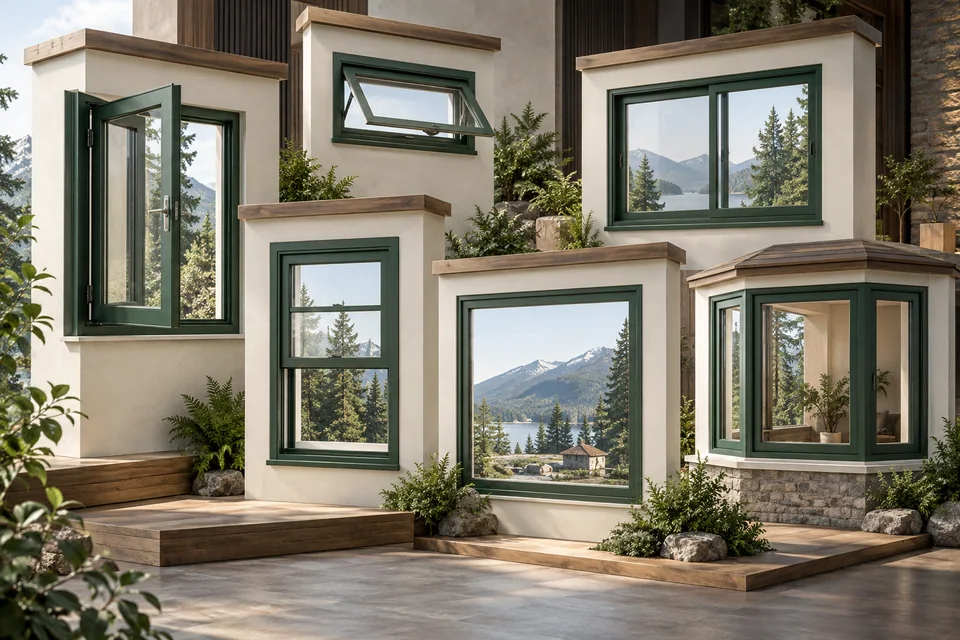
Replacement windows come in a handful of operating types. Casements and awnings swing out on hinges and seal tightly; sliders and hung windows move along tracks and are simple but usually leakier; picture windows are fixed and the most airtight. Bay and bow windows project from the wall, and patio doors are priced separately. The type sets ventilation, egress, cleaning access and cost.
- Fixed windows are the most airtight; casements and awnings usually seal tighter than sliders and hung windows.
- Bedroom windows must be able to act as an emergency exit, which favours casements and large sliders over small awnings.
- Changing a window's type or operation can trigger a permit in some cities; Calgary lists it explicitly.
- In the planner, a medium vinyl casement plans at $900 to $1,500 and a medium slider at $700 to $1,200.
- Bay and bow windows plan as a fixed $4,000 to $9,000; patio doors at $2,500 to $6,000 before frame and glazing multipliers.
01 /What are the main types of replacement windows?
Replacement windows fall into three families: windows that swing on hinges (casement and awning), windows that slide along a track (sliders and single- or double-hung), and windows that do not open (picture or fixed). Bay, bow and garden windows are assemblies that project from the wall, basement windows are a category of their own, and patio doors are glazed doors usually quoted alongside windows.
| Type | Base planning range | How the planner adjusts it |
|---|---|---|
| Casement | $900 to $1,500 | Size, frame and glazing multipliers apply |
| Awning | $850 to $1,400 | Size, frame and glazing multipliers apply |
| Slider | $700 to $1,200 | Size, frame and glazing multipliers apply |
| Single or double hung | $750 to $1,300 | Size, frame and glazing multipliers apply |
| Picture / fixed | $650 to $1,200 | Size, frame and glazing multipliers apply |
| Basement | $700 to $1,400 | Size, frame and glazing multipliers apply |
| Bay / bow | $4,000 to $9,000 | Fixed range; size, frame and glazing multipliers do not apply |
| Patio door | $2,500 to $6,000 | Fixed range; frame and glazing multipliers apply |
02 /Casement and awning windows
A casement window is hinged at the side and swings outward with a crank or handle; an awning window is hinged at the top and swings out from the bottom. Both close by pulling the sash tight against the weatherstrip, which is why they usually seal better than sliding windows. Casements catch breezes well and, with the right hinges, open fully for cleaning and emergency exit. Awnings can stay open in light rain, which makes them useful in bathrooms, over kitchen counters and in basements.
- Strengths: tight seal, good ventilation, full opening on casements, clean look.
- Watch-outs: operators and hinges are moving parts that wear; an open casement projects into walkways, decks or window wells.
- Egress: a casement with hinges that allow a full, clear opening often suits bedroom egress; a small awning usually does not.
- Planner: casement $900 to $1,500, awning $850 to $1,400 (medium, vinyl, double, insert).
03 /Sliding and hung windows
A slider has one or two sashes that move sideways along a track. A single-hung window has a fixed upper sash and a lower sash that slides up; a double-hung window has two sashes that both move, and many tilt inward for cleaning. These windows are simple, do not project into the room or outside, and suit traditional house styles, but their sliding seals generally leak more air than compression seals.
CMHC's 2005 fact sheet on window ratings observed that fixed windows tend to rate tighter for air leakage than operable ones and that sliders tend to be leakier than casements. NRCan's retrofit guide goes further on one variant: sashless sliders, panes of glass not encased in a frame, are inefficient and are better replaced.
- Strengths: lower cost, nothing projects, familiar operation, good for walkways and decks.
- Watch-outs: only half the opening is usable, tracks collect grit, hung-window balances wear out.
- Egress: a slider or hung window must still provide the full required clear opening with one sash open.
- Planner: slider $700 to $1,200, single or double hung $750 to $1,300.
04 /Picture and fixed windows
A picture or fixed window does not open. With no moving sash, it has the most glass for its size, the fewest parts to wear and the lowest air leakage. It is often combined with operable units on either side or below, such as a picture window flanked by casements. The planner prices a medium vinyl picture window at $650 to $1,200.
Large fixed units are heavy, particularly with triple glazing, and may need tempered or laminated glass depending on their size and position. Ask the supplier which panes need safety glass and whether a large unit needs two installers or lifting equipment.
05 /Bay, bow and garden windows
A bay window is an assembly of three windows set at angles, projecting from the wall, usually with a large centre unit and operable flankers. A bow window uses four or more equal units in a gentle curve. A garden window is a small box-shaped projection, often over a kitchen sink, with glass on the sides and top and shelves for plants.
All three project beyond the wall, so they need structural support (brackets, cables or a framed base), a roof or cap above, and an insulated seat and head. That makes them among the most complex replacement jobs. The planner treats bay and bow windows as a fixed $4,000 to $9,000 per unit, without size, frame or glazing multipliers, because the assembly rather than the glass drives the cost. Garden windows are not a separate planner type; quotes vary.
06 /Basement windows
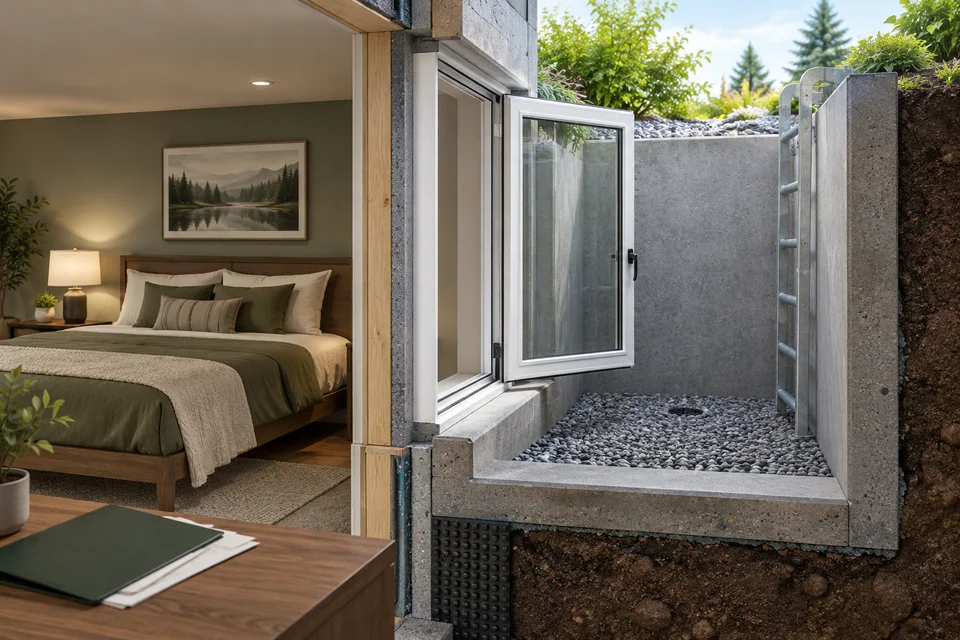
Basement windows sit in a concrete foundation wall or a wood-framed knee wall above it, often below or near grade in a window well. They are typically small sliders, awnings or hoppers (hinged at the bottom and opening inward). Replacing one like for like is usually straightforward; enlarging one to create a legal bedroom exit is a different project that involves cutting concrete, a larger window well and a permit.
The planner prices a medium basement window at $700 to $1,400 as a separate type. If you are thinking about a basement bedroom, read the permits and egress guide first; Calgary, for example, requires a building permit to add or enlarge windows and a professional engineer's review when a new foundation opening is wider than 1.2 m.
07 /Patio doors
Patio doors are glazed doors to a deck, patio or yard. Sliding patio doors have one fixed and one moving panel; hinged patio doors, often called French or garden doors, swing on hinges. Many window projects include one. The planner prices a patio door at $2,500 to $6,000, with frame and glazing multipliers applied but not size, because door panels come in a narrow range of standard widths and heights.
NRCan's retrofit guide suggests replacing sliding patio doors in poor condition with ENERGY STAR units, or with French or garden-style doors plus additional energy-efficient windows, and replacing weatherstripping and hardware on older doors when worn. Doors have their own ENERGY STAR ratings, so ask for the door's certified numbers separately.
08 /How do you choose the right window type for each room?
| Room | Common choices | Why |
|---|---|---|
| Bedroom | Casement or large slider | Emergency exit opening, ventilation |
| Living room | Picture with casement flankers, or bay | Maximum glass with some ventilation |
| Kitchen over counter | Awning, casement or garden window | Easy to operate over a counter; awning sheds light rain |
| Bathroom | Awning with obscure glass | Ventilation with privacy |
| Beside a deck or walkway | Slider or hung | Nothing projects into the path |
| Basement | Slider, awning or hopper; casement for egress | Size, window well and egress |
| Stairwell or tall wall | Fixed | Hard to reach; safety glass may be required |
Be careful about changing type. In Calgary, the City's renovation guidance says no permit is required for replacing windows without changing the size of the opening or the type or operation of the window, which implies that changing type or operation may need one. Confirm with your municipality. Once you have a list, put each opening into the Window Replacement Planner, compare frame options in the frame materials guide, and request quotes.
FAQQuestions people ask
Which window type is the most energy efficient?
Fixed windows, because they have no moving sash and leak the least air. Among operable windows, casements and awnings usually seal tighter than sliders and hung windows. Compare certified ratings for the exact types.
Is a casement or slider better?
Casements usually seal better, ventilate better and open fully; sliders cost less, have fewer mechanical parts and do not project. Choose casements for bedrooms and draughty exposures, sliders beside decks and walkways.
What is the difference between a bay and a bow window?
A bay uses three windows at angles, usually a large centre unit with two flankers. A bow uses four or more equal units in a curve. Both project from the wall and need structural support and a roof.
Can I change a slider to a casement when I replace it?
Usually, if the opening suits it. Some municipalities treat a change of operation as needing a permit; Calgary's guidance lists type or operation changes alongside size changes. Check locally, and check bedroom egress.
Are replacement windows available for exterior doors and garage doors?
Glass inserts for doors and garage door panels are separate products from house windows. Patio doors are commonly replaced with windows; ask the supplier about door glass kits separately.