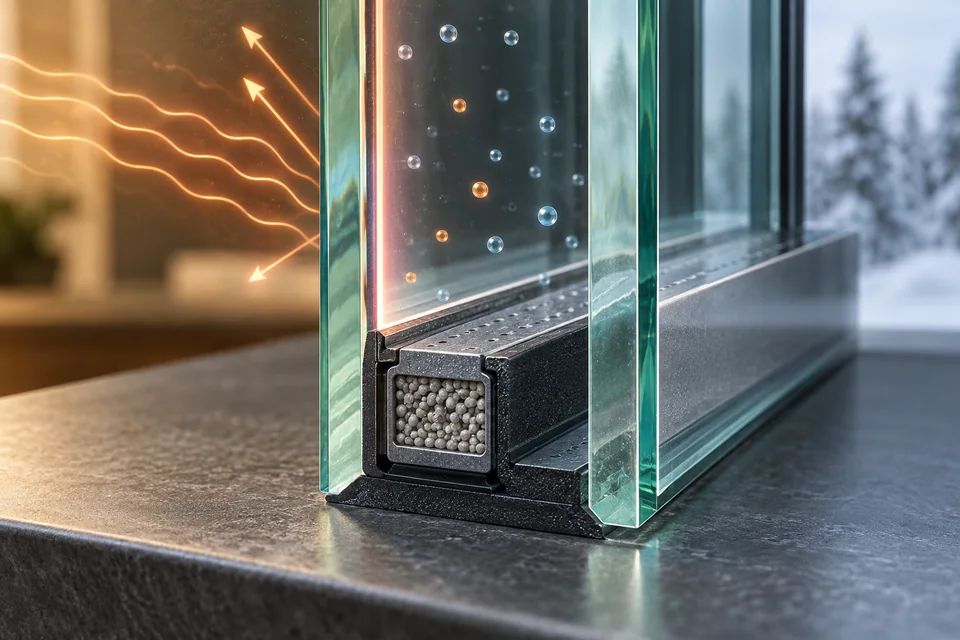
An insulating glass unit combines panes, a controlled gap, spacer, moisture management and an edge-seal system. The gas and coatings influence heat transfer, while the edge must manage moisture, gas loss, movement and thermal bridging. Durability certification is useful evidence, but it does not establish a fixed service life or make every spacer or gas option equivalent.
Canadian planning context. Technical examples from other regions are identified in the guide; approval and performance requirements must be checked for the actual building and jurisdiction. Original explanatory diagrams are not construction details.
- An IGU is a factory-sealed assembly; the frame’s rain drainage is a separate system.
- Warm edge describes reduced edge thermal conduction, not proof that a window will remain free of condensation.
- Argon or krypton selection depends on the complete gap and glazing design.
- Accelerated durability tests and optional gas-content certification answer different questions.
- Newly published CAN/CGSB-12.8-2026 is distinct from the edition referenced in a particular programme or adopted code.
01 /Identify the parts of a sealed unit
The panes define the optical and structural layers. A spacer keeps their edges separated and helps establish the cavity width. Desiccant controls residual moisture inside the cavity. Seal materials bond the perimeter and resist the passage of moisture and gas according to the designed system. Coatings and any gas fill influence energy performance. Every element needs compatibility with the others.
These factory seals are different from the sash weatherstrip and the frame-to-wall seal. A glazing unit can remain clear while the window leaks air around the sash; a perfectly latched sash can contain a failed fogged unit. The frame also needs a means of managing water that reaches its glazing pocket under its design. Blocking drainage in an attempt to reseal the glass can create another problem.
| Boundary | Main function | Typical investigation |
|---|---|---|
| IGU edge | Controlled sealed cavity between panes | Persistent fog within the unit, seals and glass records |
| Sash-to-frame gasket | Operating closure’s air and water performance | Latch, weatherstrip and operator adjustment |
| Frame-to-building junction | Connection with wall air and water control | Flashing, perimeter sealing, insulation and drainage detail |
02 /The spacer is both a distance keeper and a heat path
The spacer’s material and geometry affect heat transfer near the pane edge. A highly conductive edge can make the interior perimeter colder than the glazing centre. Warm-edge designs aim to reduce this bridge, but the term covers several constructions. Stainless-steel, hybrid, polymeric and other systems have different properties; the full unit and frame determine the resulting surface temperatures.
The right comparison is not the colour of the spacer or a promise that warm edge prevents all condensation. Ask for the complete product’s energy rating, its condensation method where available, and the actual spacer designation. A warm spacer does not correct a conductive frame corner, missing installation insulation or excessive local moisture. In small windows and divided assemblies, edge length is substantial relative to glass area, so the spacer can matter more than a centre-glass-only comparison suggests.
03 /Gas fill changes one part of the thermal system
Replacing air in a cavity with an appropriate inert gas can reduce heat transmission for the designed gap. Argon is common; krypton can be useful in narrower cavities but is a different cost and supply choice. The best gap is not infinitely wide: gas conduction, convection, coatings and pane arrangement interact. Ask for the rated make-up rather than ordering the widest gap and most expensive gas on principle.
Gas fill does not make a window vacuum glazing. A normal gas-filled unit still has pressure inside, and it still exchanges heat through the edge and radiation between panes. Nor does a gas label establish acoustic performance, because sound behaviour depends on pane mass, separation, damping and the complete sealed closure. The acoustic-ratings guide explains that separate investigation.
Request the specified initial gas content and the supporting certification or quality process if it is important to the order. Do not repeat a universal annual percentage loss as though every IGU experiences the same ageing. Seal construction, fabrication, temperature, installation and exposure all affect durability. A particular warranty may also define a visual seal failure differently from a measurable change in gas concentration.
04 /Desiccant and seal design are moisture management
Even carefully assembled glazing contains a finite moisture burden. Desiccant takes up moisture in the cavity so normal temperatures do not create visible internal condensation. The edge system limits further ingress. If moisture eventually exceeds the system’s ability to control it, condensation or deposits can appear between panes. Persistent internal haze and droplets need a glazing-service assessment; they should not be diagnosed as high room humidity alone.
Dual-seal systems often use materials with different tasks, such as a moisture/gas barrier and a supporting secondary seal. That is a design family, not an instruction to apply household sealant around an installed unit. The fabricator chooses sealants, coating-edge preparation and spacer components as a compatible system. Field treatment cannot simply recreate a factory-assembled cavity.
Some visible deposits can have other causes, and surface haze can be mistaken for an internal problem. Document where the mark lies and how it varies with temperature before deciding that every pane needs replacement. A service technician can examine seals, glass markings and accessible surfaces without promising an instant diagnosis from one photograph.
05 /What accelerated durability certification proves
IGU durability programmes expose representative specimens to defined accelerated conditions and evaluate specified outcomes. IGCC provides certification resources and listings for participating insulating-glass products. Such certification supports a claim that a product system meets the programme’s requirements; it is not a countdown predicting exactly how many years your installed unit will last.
Gas-content certification may be an additional defined scope rather than an automatic feature of every durability listing. IGCC’s published programme documentation describes initial and after-weathering gas evaluations. Check the current listing and scope for the actual fabricator and unit system instead of treating the organisation’s logo as evidence of every optional property. Do not apply a laboratory ageing sequence as a direct equivalent to a fixed number of outdoor years.
| Evidence | It helps establish | It does not automatically establish |
|---|---|---|
| Durability listing | Participation and specified performance under a defined programme | Every unit has a promised field lifespan |
| Gas-content scope | Defined gas measurement/certification requirements | No future gas change |
| Whole-window energy record | Energy performance of the specified model | Long-term seal durability |
| Safety mark | Applicable glazing safety performance | IGU weathering certification |
| Warranty | Contractual remedies and conditions | A laboratory-tested service life |
06 /Pressure, altitude and pane deflection
A sealed unit’s cavity pressure responds to temperature and the conditions under which it was sealed, transported and installed. Changes in altitude and weather can cause panes to bow. Larger panes, glass thickness and cavity volume influence the response. Deflection can affect appearance and loads, so the fabricator needs to know the delivery and installation location, especially where transport crosses substantial elevation differences.
Manufacturers may have specific pressure-equalisation or altitude procedures. These can have consequences for gas fill and the final sealed state. Do not improvise a vent hole, reopen a seal or assume a capillary tube is appropriate for every unit. Ask how the finished assembly will satisfy its energy and durability specification at the project location. A unit intended for one elevation may need additional review before reuse elsewhere.
Reflected images may show some distortion due to pane deflection, even without a seal failure. Appearance acceptance and structural suitability are separate questions. If deflection is unexpected, provide the fabricator with dimensions, thicknesses, location and temperature history rather than concluding from a curved reflection that the unit is dangerously overstressed.
07 /Glazing support and drainage affect durability
The frame must support the unit at the intended locations without creating excessive edge stress. Setting blocks, clearances, gaskets and sealants form part of the manufacturer’s glazing system. Large or heavy units increase the importance of adequate support and handling. A thick triple unit should not be inserted into a frame merely because it can be forced into the rebate.
Water trapped against an edge seal can create unfavourable exposure. Follow the frame and glass suppliers’ drainage and compatibility instructions, and preserve designed weep paths. A neat line of exterior caulk does not prove the glazing pocket is dry or the wall junction is correct. The flashing and sealing guide addresses the installation interface; this guide addresses the sealed glass within it.
08 /Canadian standards can have different referenced editions
The CGSB catalogue lists CAN/CGSB-12.8 Insulating glass units as a March 2026 publication. A particular certification programme, contract or adopted code may still reference another edition. The Canadian ENERGY STAR version 5 specification, for example, names ASTM E2190-10 and/or CAN/CGSB 12.8-17 in its IGU requirements. Publication, programme qualification and regulatory adoption must be checked separately.
Ask which edition and scope the offered certification actually covers and whether it satisfies the project’s requirements. Do not reject a product solely because its record names an older referenced edition if that is the edition the applicable programme requires; equally, do not assume a current marketing brochure resolves the contractual requirement. A qualified supplier should explain the record and any needed transition.
09 /Replacement, warranties and the evidence worth keeping
A failed IGU can often be replaced while a suitable frame and sash remain, but first assess their condition, support and compatibility. The replacement needs the correct dimensions and thickness, coatings and orientation, gas and spacer, pane treatments and safety requirements. Replacing only clear glass with a generic unit can alter both comfort and the required safety performance.
Keep the unit’s manufacturer or fabricator identifier, production information, exact make-up, rating record and warranty terms. Glass warranties can distinguish between seal failure, breakage, labour, access and collateral finishing. Clarify who pays for removal and reglazing, not only whether replacement glass is supplied. Document any defect while records and purchase details are available.
- Is the haze on an accessible surface or inside the cavity?
- Does the warranty cover this failure mode, labour and access?
- Is the frame suitable to retain, and is drainage functioning?
- Will the replacement preserve coating, safety, acoustic and thermal requirements?
- What record will identify the new unit for future service?
A drilled defogging treatment may change visible moisture but must not be described as restoring the original factory gas, seals and certified performance without evidence. Compare repair proposals on what they actually restore. For the wider decision, see repair or replace windows.
FAQQuestions people ask
Does warm edge eliminate condensation?
No. It reduces one thermal bridge. Room moisture, frame temperatures, local air movement and installation still affect condensation.
Can I tell how much argon remains by looking at the glass?
No. Visual clarity does not measure gas concentration. Assessment requires suitable records or measurement methods.
Does IGCC certification establish a lifetime service life?
No. It addresses defined programme requirements for the listed system. Warranty remedies and field durability are separate.
Can a fogged unit be resealed on site to its original rating?
Do not assume so. A proposal must explain how the factory cavity, gas, desiccant, seals and performance would actually be restored; replacement is a distinct option.
SOURCESSources and further reading
- IGCC — Certification resources and scope; insulating-glass programme
- IGCC — August 2023 certification programme document, including optional gas-content scope; check current listing
- Canadian General Standards Board — Standards catalogue, insulating glass units edition dated March 2026
- Natural Resources Canada — Canadian ENERGY STAR fenestration specification, version 5.0; Canadian certification scope
- DOE Building Science Education — High-performance window systems: glass; conventional glazing, gas and low-e overview, not Canadian code
- Natural Resources Canada — Keeping the Heat In, section 8; Canadian retrofit guidance