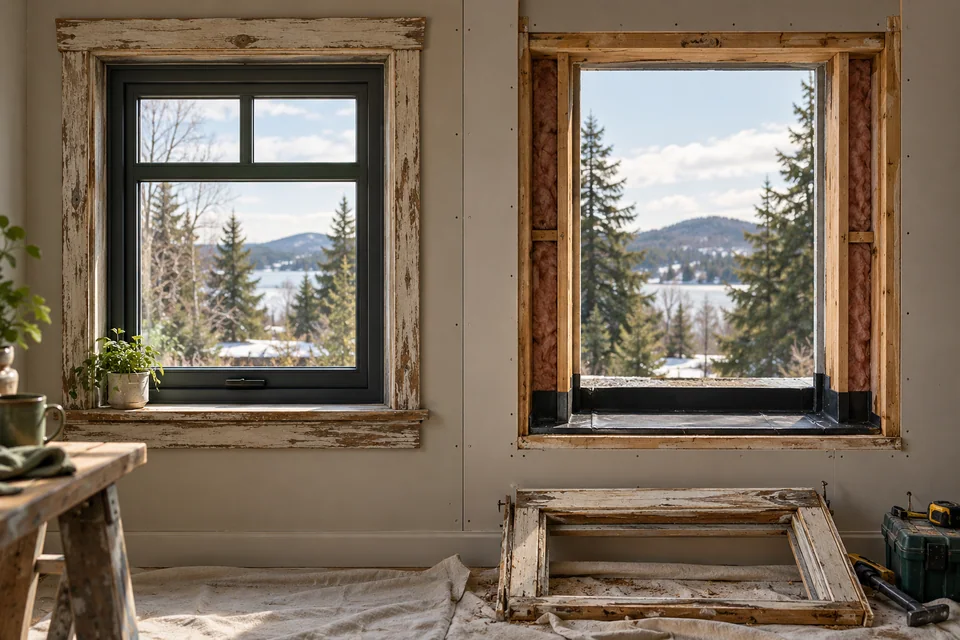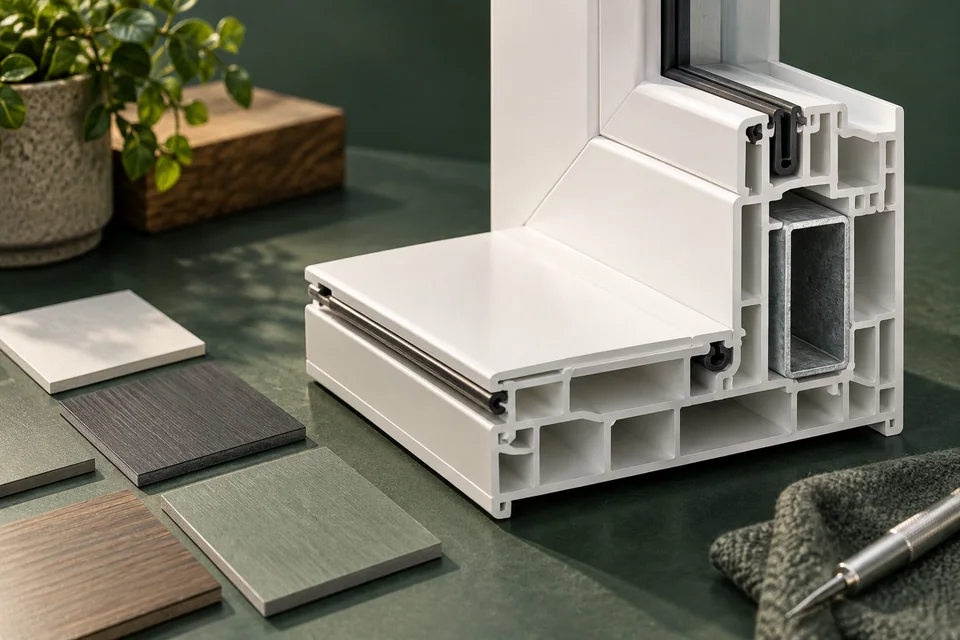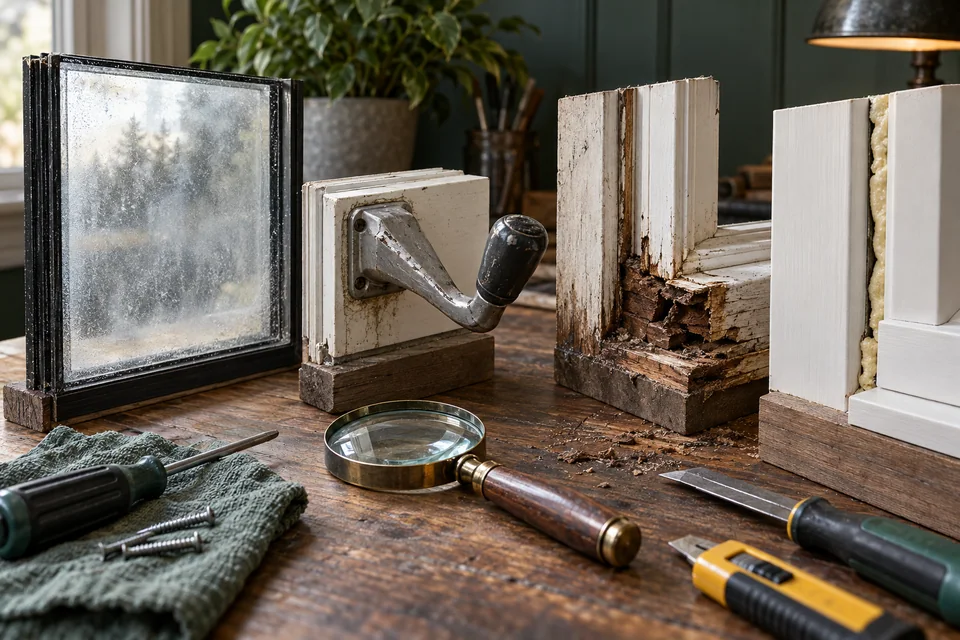
Repair a window when the problem is in a replaceable part and the frame is sound: a fogged glass unit, a worn crank or balance, tired weatherstrip or a leaky trim seal. Replace the whole window when the frame is rotten, cracked or out of square, when water gets in around it, when it is single-glazed and uncomfortable, or when several parts are failing at once.
- Fog between the panes means the glass seal has failed; replacing just the glass unit is often possible when the sash is sound.
- NRCan describes 'defogging' or refurbishing failed sealed units as a temporary fix that does not restore original efficiency.
- Cranks, locks, hinges, balances, rollers, screens and weatherstrip are replaceable parts on most windows.
- Draughts around the trim are usually a wall-to-frame air sealing problem, not a reason to replace the window.
- Rot, a racked frame or water getting into the wall are the clearest reasons to replace, usually full-frame.
01 /Should you repair or replace your windows?
Start by identifying which part of the window is failing. A window is a frame, one or more sashes, a sealed glass unit, weatherstrip, hardware and the installation that ties it to the wall. Most of those parts can be replaced individually. The window as a whole only needs replacing when the frame or the installation has failed, or when repairs would cost a large share of a new window and leave you with old performance.
| Symptom | Likely cause | Usually repair | Replace the window when |
|---|---|---|---|
| Fog or film between panes | Failed glass unit seal | New sealed glass unit in the existing sash | Several units failing, sash damaged, or glass alone costs close to a new window |
| Crank spins, sash will not close | Worn operator or hinge | Replace operator, hinge or lock | Parts are unavailable for a discontinued line |
| Hung window will not stay up | Worn balances | Replace balances | Frame or sash is warped |
| Draught at the sash | Worn or missing weatherstrip | New weatherstrip | Sash no longer closes evenly |
| Draught around the trim | No air seal between frame and wall | Remove trim, insulate and seal the gap | Frame is damaged or leaks water |
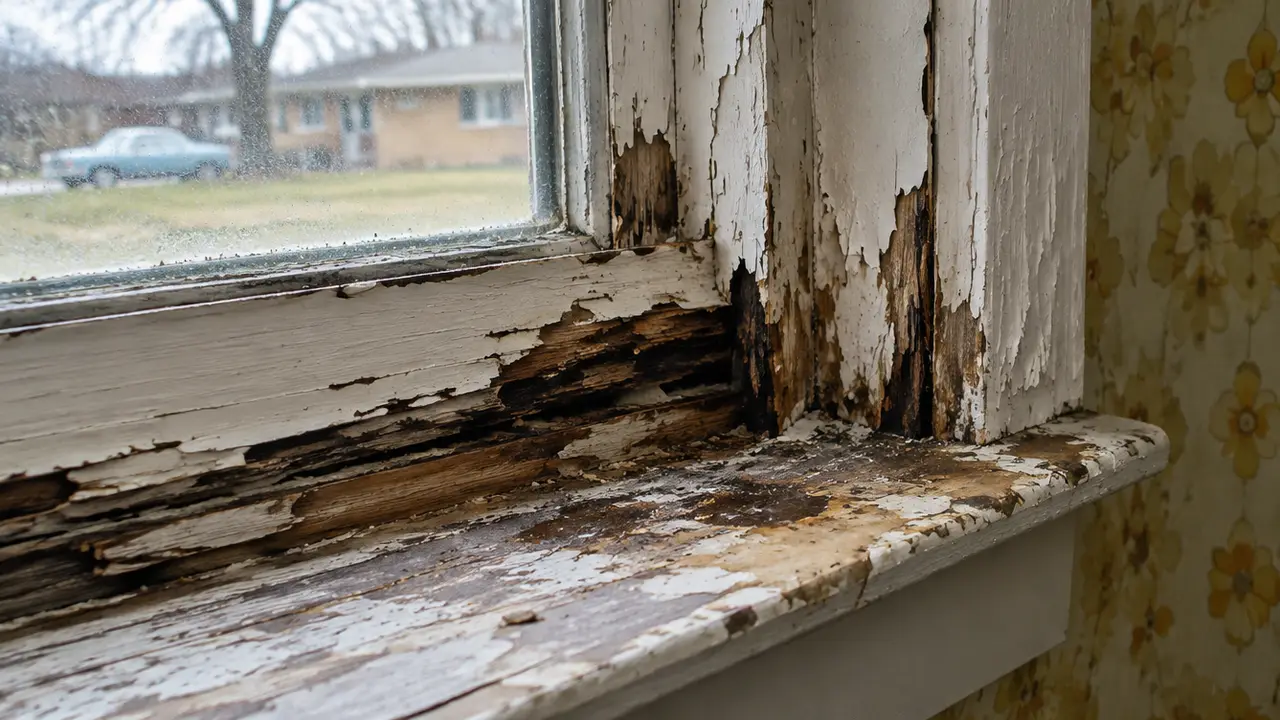
| Soft or dark wood at sill or corners | Rot from water or condensation | Small areas: consolidate and fill | Rot extends into the frame or rough opening |
| Water stains below the window | Failed flashing or sealant | Reseal only if the source is clearly the sealant | Water is getting into the wall; go full-frame |
| Single glazing, heavy frost | Poor insulation | Storm windows or inserts | You want modern performance and comfort |
02 /What causes foggy windows, and can they be fixed?
Fog, haze or water droplets trapped between the panes of a double- or triple-glazed window mean the edge seal of the sealed glass unit has failed. Moist air has leaked into the gap, the desiccant in the spacer has saturated, and the moisture now condenses on the cold inner surfaces. Any gas fill has likely escaped too. Wiping, heating or ventilating the room will not clear it.
The durable fix is a new sealed glass unit built to fit the existing sash. On many casements, awnings, picture windows and sliders, a glass shop or the window's manufacturer can remove the glazing stops, take out the failed unit and install a new one without touching the frame. NRCan's retrofit guidance is that condensation inside a sealed double-glazed unit is best corrected by replacing the glazing unit; some specialty companies can refurbish failed units, but this is a temporary fix that will not offer the original energy efficiency. It also advises checking whether the window is still under warranty.
If only one or two units have failed on otherwise good windows, replacing the glass is usually the better value. If most units in the house are failing at once and the windows are near the end of their warranty, it may be time to compare the cost of glass units against new windows using the Window Replacement Planner.
03 /Which window hardware can be replaced?
Most window hardware can be replaced: casement and awning operators (the crank mechanism), handles, hinges, locks and keepers, hung-window balances, slider rollers, tilt latches and screens. Worn hardware makes a window hard to operate and stops the sash pulling tight against its weatherstrip, which causes draughts.
- Find the maker: look for a name or code on the operator, the spacer bar or the frame. Parts suppliers can often match hardware by measuring it.
- Replace in pairs: if one operator in a line of casements has failed, the others are often close behind.
- Discontinued lines: when parts no longer exist, universal replacements sometimes fit; if not, that window is a candidate for replacement.
- Screens and screen frames are inexpensive to replace or rescreen and are not a reason to replace a window.
04 /Why is my window draughty, and does that mean replacement?
Draughts come from two very different places. Air leaking past the sash, felt when your hand is near the meeting edges of a closed window, usually means worn weatherstrip or hardware that no longer pulls the sash tight. Air leaking around the trim, felt at the joint between the casing and the wall, comes from the gap between the window frame and the wall framing, which was never properly sealed.
Both are repairs, not reasons to replace. NRCan's retrofit guide describes sealing the trim with a continuous bead of interior caulk, and for leaky windows, removing the trim, insulating the gap and sealing it before reinstalling the trim: insulation plus caulk for gaps of about 6 mm or less, and backer rod with caulk or low-expansion foam for larger ones. It also covers weatherstripping by window type: V-strip on hung windows, brush strip in slider tracks, and compression strip on casements.
05 /Can rotted wood windows be repaired?
Small areas of rot in wood sashes and sills can often be repaired. A carpenter or restoration specialist removes the decayed wood, consolidates what remains with an epoxy consolidant, fills and shapes it, or splices in new wood, then primes and paints. That keeps original windows in heritage homes and is usually cheaper than a new custom wood window.
Replacement is the better choice when rot extends through the sill into the frame corners, when the rough opening or wall framing below is soft, or when the cause, usually water from outside or heavy winter condensation running down the glass, cannot be fixed. Rotted frames call for full-frame replacement so the opening can be inspected and repaired; an insert would seal the rot in.
06 /What about old single-glazed windows?
Single-glazed windows lose far more heat than modern units. NRCan notes that a single-glazed window loses about 10 to 20 times as much heat as the same area of properly insulated wall, and that storm windows or double-glazed sealed units reduce that loss by almost half. Modern high-performance windows go further.
Replacement is the most complete upgrade, but it is not the only one. Exterior or interior storm windows, sash inserts that keep the frame, or careful weatherstripping can make older windows much more comfortable, which matters in heritage homes and where original windows are protected. NRCan's guidance notes that when exterior storms are used, the inner window should be sealed more tightly than the storm so moist house air does not get trapped between them and condense.
07 /What are the signs it is time to replace windows?
- Rot, cracks or distortion in the frame itself, not just the sash or glass.
- Water stains, soft drywall or peeling paint below the window after rain.
- Several failing parts at once: fogged glass, worn hardware and draughts on the same window.
- Parts no longer available for the product line.
- Single glazing or sashless sliders in rooms you want to be comfortable in winter.
- Heavy condensation or frost on the frames and glass even with reasonable indoor humidity.
- You want a different window type, more glass, or a compliant bedroom exit.
If only some windows meet these tests, replace those and repair the rest; a phased plan is normal. When you are ready to price it, read is window replacement worth it and the cost guide, then request quotes for the openings that need it.
FAQQuestions people ask
Is it better to repair or replace windows?
Repair when the frame is sound and the problem is in a replaceable part such as the glass unit, hardware or weatherstrip. Replace when the frame is rotten, cracked or out of square, water is getting in, or several parts are failing together.
Can a fogged double-pane window be fixed?
Yes, by replacing the sealed glass unit in the existing sash. Defogging services that drill and dry the unit are, in NRCan's words, a temporary fix that does not restore the original efficiency.
Can vinyl windows be resealed?
The glass unit's internal seal cannot be restored once it fails; the unit is replaced. The exterior sealant between the window and the wall can and should be renewed when it cracks or pulls away.
How do I replace a window crank?
Open the window, disconnect the operator arm from the sash track, remove the trim or cover over the operator, unscrew it and fit a matching replacement. Take the old one to a parts supplier to match it. If you are unsure, a window service company can do it quickly.
Why do vinyl windows fail?
Most failures are in the glass seal, hardware or weatherstrip, or come from installation problems such as blocked drainage or a stressed frame. Cracked corner welds and warping are less common and usually warranty matters.
Does homeowners insurance cover a fogged window?
Usually not. Seal failure is treated as wear or a manufacturing defect, which is a warranty matter. Sudden accidental breakage is a different question; see the rebates, tax and insurance guide and check your policy.