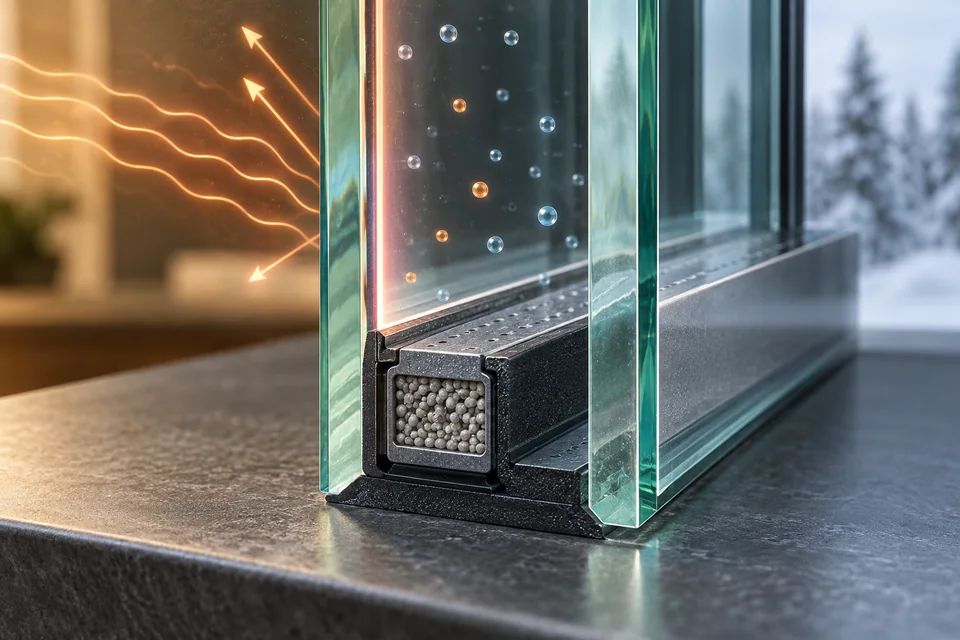
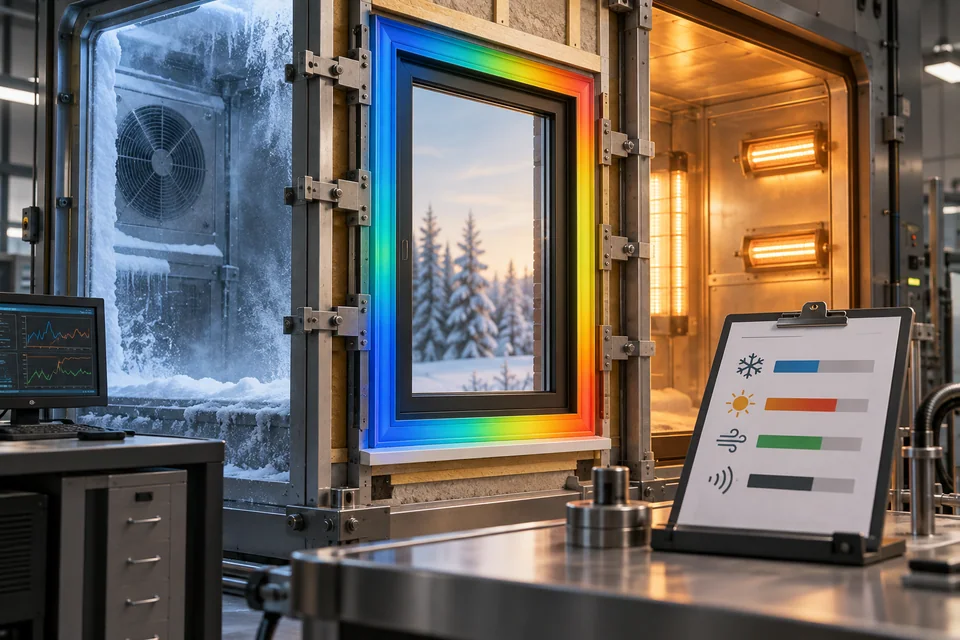
A low-e coating reduces thermal radiation exchange, while its spectral design can also control sunlight. Surface numbers locate the coating in a complete glazing assembly: outside to inside, with two surfaces per pane. Position alone does not specify performance. Compare the exact coated product, glass make-up and whole-window ratings, including solar gain, daylight and condensation behaviour.
Canadian planning context. Technical examples from other regions are identified in the guide; approval and performance requirements must be checked for the actual building and jurisdiction. Original explanatory diagrams are not construction details.
- Double glazing has four principal pane surfaces; triple glazing has six.
- A low-e coating’s composition and the complete assembly matter more than a generic surface rule.
- Coatings intended for a sealed cavity and coatings approved for exposure are different products.
- Room-side low-e can improve heat-transfer ratings while requiring separate surface-temperature consideration.
- Use records and approved detection methods; do not use a flame or scratch test.
01 /Number the assembly from outdoors to indoors
For a simple double insulating unit, surface 1 is the outside face of the outer pane, surface 2 faces the sealed cavity, surface 3 is the opposing cavity face of the inner pane, and surface 4 faces the room. A simple triple unit continues to surfaces 5 and 6 on its innermost pane. The numbering follows the panes from exterior to interior, not your position while standing at the window.
Laminated assemblies need a more explicit drawing because internal laminated interfaces and the principal glazing surfaces may be described differently in supplier documents. Ask for a cross-section that names every glass layer, cavity, coating and interlayer. A short code such as low-e 2 may be clear within one company’s system but ambiguous to the installer or replacement-glass fabricator years later.
| Surface | Location | Question |
|---|---|---|
| 1 | Outdoor exposed face | Is any special exposed coating or bird pattern specified? |
| 2 | Outer pane face toward cavity | Which exact cavity coating, if any? |
| 3 | Inner pane face toward cavity | Which exact cavity coating, if any? |
| 4 | Room exposed face | Is the coating approved for exposed use and its cleaning requirements? |
02 /Low emissivity is a radiation property
Emissivity concerns how a surface emits thermal radiation. A low-emissivity coating modifies radiative heat exchange across the glazing system. It is not a layer of ordinary bulk insulation, and it does not eliminate conductive paths through the glass edge or frame. Nor does a low-e name itself state how much solar heat or visible light the assembly admits.
Short-wave solar energy and the long-wave thermal exchange associated with room surfaces occupy different spectral ranges. Coating designers can tune their response to those ranges. This is why an insulating low-e package can admit substantial useful winter sun, while a solar-control low-e package limits more incoming solar energy. Both can have useful thermal properties. The SHGC and visible-transmittance guide explains how to compare the resulting ratings.
03 /Why coating position is not a universal recipe
Manufacturer technical explanations often distinguish a solar-control coating on the outer pane’s cavity face from an insulating coating on the inner pane’s cavity face. Such placements can be appropriate for specific products, but they are not universal assembly instructions. The same manufacturer can offer coatings approved for different surfaces, or packages with more than one low-e layer.
Guardian’s technical explanation discusses surface 2 for solar-control and surface 3 for some thermal-insulation applications; Vitro publishes its own product-specific placement guidance. Treat these as explanations of the manufacturers’ glass systems. The correct order is to select an approved complete make-up, then verify its performance. Moving a coating to another face can change solar gain, absorption, appearance or surface temperatures even if its trade name stays the same.
A field installer should not decide to reverse a sealed unit based on a general rule from the internet. The unit may include asymmetric glass, a laminate, bird markers or an exposed-surface coating as well as low-e. Obtain the manufacturer’s orientation instructions and matching unit identification before installation.
04 /Hard coat, soft coat and exposure approval
Pyrolytic coatings are often called hard coats; sputter-deposited coatings are often called soft coats. The names describe manufacturing families and handling characteristics, not a simple good-versus-bad ranking. Specific products differ in solar, thermal and optical behaviour. A coating intended to be protected inside a sealed cavity may be unsuitable for exposure to indoor cleaning or outdoor weather.
A coating approved for a room-facing surface needs the manufacturer’s service and cleaning instructions. Do not infer approval from its appearance or from the fact that another exposed coating survives. The glass schedule should identify the coating and approved position, while handover records should explain cleaning restrictions. Different coated products on one elevation can create colour or reflection differences, so a representative mock-up may be sensible.
Edge deletion—the removal of some coating at a perimeter where seals bond—is a fabrication consideration for particular products and seal systems. It is not a homeowner procedure. Ask the fabricator to confirm compliance with its coating and sealant requirements; do not use a visible coating edge as proof of correct or incorrect manufacture without the product detail.
05 /Room-side coatings and condensation require separate thought
Some assemblies use a low-e product designed for the exposed room-side surface to reduce thermal radiation exchange further. That can improve the calculated heat-transfer performance of the assembly. However, reducing radiant heat received from the room can alter the room-side pane temperature. A lower overall U-factor does not automatically mean every exposed surface becomes warmer.
This is a useful example of why one-number sales comparisons can be misleading. Ask for condensation or surface-temperature information applicable to the offered package and expected indoor conditions. Compare it with a package that achieves thermal performance through additional glazing and cavity coatings, rather than assuming the mechanisms are identical. The relevant answer is specific to the product, climate, indoor moisture and calculation method.
The moisture lab uses a measured surface temperature rather than predicting it from the coating position. If a room has persistent humidity or a specialist collection, the designer can assess the complete frame, glazing edge and wall junction. Do not use a coating diagram alone to predict dry glass.
06 /Coating counts and silver counts are not performance ratings
A sales description may count panes, low-e coatings or metallic layers. Those details describe construction choices, but do not replace certified U-factor, SHGC and VT for the actual complete product. A package with more layers is not automatically more suitable for a north room, a sunny west room or a heritage sash. Its appearance and thermal stress requirements can also differ.
Compare packages in a consistent table with the same frame, operator and rating method wherever possible. Identify what changed: one coating product, another coated surface, an additional pane or a different gap. If several things change together, avoid attributing the complete performance difference to the coating alone. A proper comparison makes the assumptions visible rather than attaching one improvement percentage to every house.
| Evidence | Why it matters |
|---|---|
| Complete make-up drawing | Removes surface-number and layer ambiguity |
| Exact coating product and position | Prevents generic low-e substitution |
| Whole-window U-factor | Includes frame and edge effects under the method |
| SHGC and VT | Separates solar control from daylight |
| Condensation method or surface assessment | Addresses local moisture concerns |
| Safety and structural glass treatments | Coatings do not establish safety compliance |
| Visual sample and cleaning guidance | Captures appearance and ownership implications |
07 /Detecting a coating without damaging the window
Coatings can change the colour or intensity of reflected light, but reflections alone do not reliably identify every product or prove the complete glass make-up. Additional panes, laminates and films complicate interpretation. If an installed unit’s orientation is uncertain, start with the spacer identification, factory records and the manufacturer’s approved detector procedure.
Do not bring an open flame to a window to count reflections. Do not scratch a surface to see whether it has a coating or remove a bead to satisfy curiosity. Those approaches can damage finishes, glass or seals, and do not establish certified performance. A service provider with appropriate instruments can document coating presence and position within the instrument’s capabilities. A detection result still needs to be matched with the correct product record.
08 /Film, privacy and reflective appearance
An applied film is a separate product added to a glazing assembly. It can alter solar absorption, visible transmission, reflection and thermal stress. It may affect the warranty. Before combining film with low-e glass, obtain written compatibility for the exact pane treatments, cavity construction and film. A generic assurance that film works on double glazing is insufficient.
Reflective privacy is lighting-dependent: a room lit brightly at night can be visible from a dark exterior even if its window appears mirror-like by day. Low-e is not an automatic privacy solution. Exterior reflectance also affects bird-collision risk and neighbouring views. Consider screening, blinds or other planned treatments for privacy rather than forcing all requirements into one coating choice.
Low-e and laminated packages can reduce some ultraviolet transmission, but no coating should be claimed to eliminate every form of fading. Heat, visible light, materials and exposure time remain relevant. Sensitive art or furnishings need an exposure strategy, not only a coating specification.
09 /Keep the delivered make-up traceable
At order approval, retain the window schedule, rating record, glass drawing and special coatings. At delivery, compare identification and orientation against those records. Ask how substitutions will be approved and how an incorrect unit will be distinguished from an acceptable manufacturing variation. These steps matter especially when different elevations receive different solar packages.
For future replacement, a glass service company needs more than the pane dimensions. Provide the coating product, surface location, pane treatments, lamination, gap and spacer, along with the frame’s glazing requirements. The IGU edge-seal guide follows the rest of the assembly. Good records help preserve performance after an isolated glass failure without replacing every window.
FAQQuestions people ask
Should low-e always be on surface 2?
No. Position is product- and assembly-specific. Some solar-control packages use surface 2; other systems use other approved surfaces or several coatings. Verify the manufacturer’s complete make-up.
Can a room-side low-e coating make condensation worse?
It can change the exposed pane’s temperature, so overall U-factor alone is not enough. Ask for assessment of the actual assembly and moisture conditions.
Does triple silver mean triple glazing?
No. Metallic-layer terminology describes a coating construction; triple glazing describes three panes. Neither name replaces whole-window ratings.
Can I identify the coating with a candle?
Use records or an approved detection procedure. Open flames and scratch tests are unnecessary and can create hazards or damage.
SOURCESSources and further reading
- Guardian Glass — Low-e glass, coating manufacture and surface placement; manufacturer guidance
- Vitro Architectural Glass — Optimal coating placement for double and triple IGUs; manufacturer guidance
- Vitro Architectural Glass — Interior and exterior condensation; glass-system explanation
- Guardian Glass — Product processing guidance; coating detection and identification
- NFRC — Residential product certification; North American whole-product energy ratings