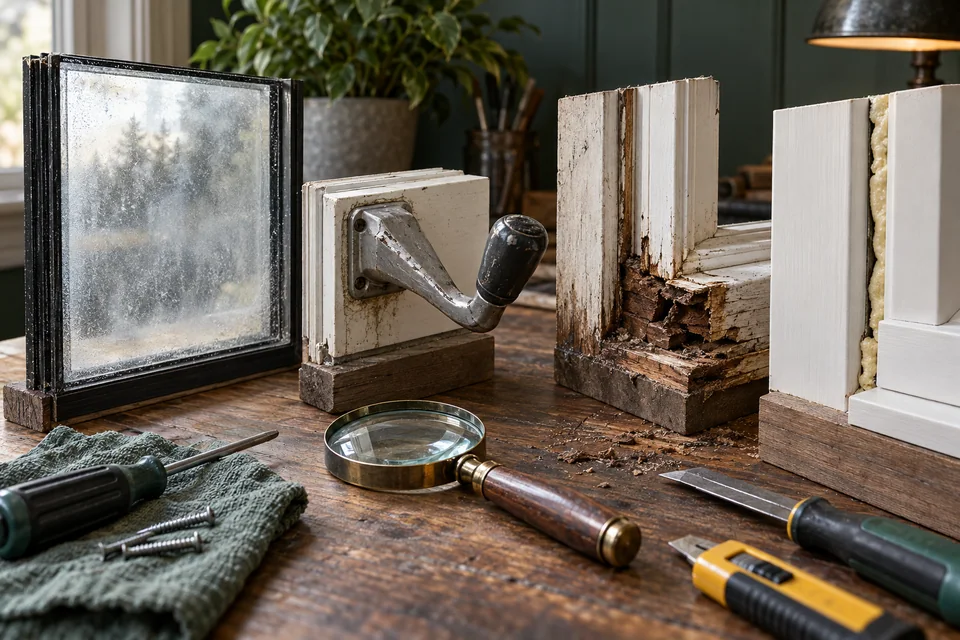
A historic window needs a condition survey before a replacement decision. Separate the sash, frame, glazing, hardware and wall interface; establish what gives the window significance; and compare a sample repair with replacement on the same scope. Retaining a sound historic assembly can preserve valuable details while targeted weatherstripping or secondary glazing improves comfort.
Canadian planning context. Technical examples from other regions are identified in the guide; approval and performance requirements must be checked for the actual building and jurisdiction. Original explanatory diagrams are not construction details.
- An old window is an assembly of repairable parts, not a single disposable object.
- Age, peeling paint and a broken sash cord do not establish that the entire window is beyond repair.
- Protect original glass, profiles and hardware while investigating the source of decay.
- Lead paint and other hazardous materials change the repair method and containment requirements.
- A sample repair reveals access, workmanship and performance before committing to a whole building.
01 /Begin with significance and a numbered survey
A conservation project starts with two questions: what is important about this window, and which parts are actually failing? Original sash proportions, narrow meeting rails, curved glass, moulded profiles, distinctive joinery or a repeated pattern across a façade can matter even when the paint looks poor. Later alterations can also carry historical value. Record what exists before deciding what an ideal replacement ought to look like. An undocumented removal can destroy evidence needed to reproduce a missing detail later.
For Canadian heritage work, use the Standards and Guidelines for the Conservation of Historic Places in Canada alongside the building’s designation, conservation plan and local approval process. A national guideline is not permission to alter a particular designated property. The U.S. National Park Service repair brief provides a useful international technical framework for assessing wooden windows; its regulatory context is American.
Give each opening an identifier and photograph the exterior, interior, glass, hardware, sill and visible defects. Note which sashes operate, which remain painted shut and which pieces appear to be replacements. Keep significance separate from condition: a highly significant window can be badly damaged, while a sound later unit may contribute little to the heritage character.
02 /Inspect components without turning the survey into demolition
| Component | Useful observation | Decision to defer |
|---|---|---|
| Sash and joints | Loose joints, distortion, paint breakdown and visible loss | Do not infer hidden decay from a photograph alone |
| Frame and sill | Wet areas, end grain, soft spots identified by an appropriate inspection | Determine whether water comes from glazing, roof or wall |
| Glazing | Cracks, loose bedding, unusual glass and missing putty | Retain significant panes where safe and feasible |
| Operation | Cord, chain, balance, pulley, hinge, lock and travel | Identify the mechanism before prescribing a replacement part |
| Wall interface | Staining, failed finish and previous patches | Assess concealed framing only with a planned opening-up scope |
Record the inspection method and the limits of access. A sill may be dry on a sunny afternoon but repeatedly wet during driven rain. A probe can damage a fragile finish or historic surface and should be used deliberately by someone who understands the material. Mark suspected defects as suspected until opening-up or specialist inspection confirms them. This makes the survey useful for pricing without pretending to know what is behind the plaster.
Compare windows on sheltered and exposed elevations. If decay clusters below one gutter or at a particular sill detail, a water-management problem may be driving the failures. Replacing every sash without correcting that cause can reproduce the problem in new timber. Conversely, scattered worn cords may be ordinary service work rather than evidence of systemic frame failure.
03 /Use a repair hierarchy rather than one treatment everywhere
The practical hierarchy is to maintain sound material, repair a local defect, replace a failed component and consider whole-window replacement only when the earlier options cannot meet the project’s requirements. A sound sash with one failed rail is a different job from extensive decay through the frame and rough opening. Retaining most of a window does not mean keeping structurally unsound wood or concealing an active moisture source.
A conservation carpenter may propose a fitted timber splice, joint repair, local consolidation or a new component with a matching profile. Ask why the treatment suits the particular defect. A filler that produces a neat surface is not automatically a structural repair. The proposal should describe how the repaired piece will shed water, receive a finish, move with the surrounding timber and remain inspectable.
Preserve removed pieces until the repair is accepted. They can serve as profile samples, explain previous alterations and help identify hardware. Agree in advance which pieces return to the owner, which become templates and which may be disposed of after hazardous-material requirements are addressed. A labelled storage plan is inexpensive compared with reconstructing a lost sash section from memory.
04 /Old coatings and glazing need a controlled work plan
Historic paint and glazing materials may contain hazardous substances. Do not assume that a particular colour, building age or intact top coat makes scraping safe. Arrange an assessment appropriate to the property, proposed disturbance and local requirements. The work plan needs to cover residents, workers, neighbouring spaces, dust, cleaning, waste and reoccupation, not merely the person holding a sander.
Health Canada describes lead paint risks and precautions in its lead-based paint guidance. That resource does not establish a universal safe stripping method for every historic assembly. Ask the restoration contractor to identify the products and containment procedure they will use. Aggressive heat, abrasives or uncontrolled dust can harm people, glass and delicate profiles.
Do not make broken-glass removal a casual owner task. Old panes may have irregular thickness, sharp edges and value that is not obvious until they are examined. Stained or leaded glass needs its own conservation assessment. Plan secure temporary closures before a sash leaves the opening; weather exposure, access, emergency escape and building security continue during workshop repair.
05 /Restore operation as part of the energy and comfort work
A window that looks restored but cannot move or latch correctly is an unfinished project. In a hung window, ask whether the sash weight or balance suits the sash, whether travel is smooth and whether the meeting rails align when closed. For casements, review hinges, stays, locks and the clearance needed to swing. Changing glass or adding hardware may change weight and loading; the original mechanism should not be assumed suitable without review.
Weatherstripping must suit the profile and motion. A product that makes the sash too tight can trade an air-leakage complaint for an inaccessible or unusable window. Evaluate the closing force, visible contact and operation after the coating has cured. Keep necessary drainage paths clear. Caulking an operable window shut is not an acceptable substitute where the opening is needed for ventilation or emergency escape.
Try one repaired window through a realistic sequence: unlock, open, hold or support as intended, close and latch. Check it with screens or a secondary panel in place. A room user may have different reach, grip or strength from the workshop technician. Include those requirements in the repair brief before hardware is ordered.
06 /Improve comfort while respecting the original assembly
Repair, perimeter air sealing, compatible weatherstripping and a well-designed storm or secondary window are separate options. Compare them individually and together. A secondary panel can preserve historic glass and sash profiles, but its position affects blinds, cleaning, sightlines and access to the primary sash. It also creates a cavity whose moisture behaviour must be considered.
Changing an old single-glazed sash to a heavy insulating glass unit is a design decision, not a simple glass upgrade. The rebate depth, glazing support, weight, hardware, visible profiles and moisture detailing all need review. A larger rebate can remove material from a delicate sash. Ask for a drawing and a sample rather than accepting a general promise that modern glass will fit.
Compare the outcome against the actual comfort problem. A draught at the frame-to-wall joint may persist even after new glass is installed. Overheating on a sunny elevation may need shading rather than more panes. This is why a room-level brief should accompany the component survey: desired comfort, ventilation, sound, daylight and conservation outcomes are related but not interchangeable.
07 /Commission a representative sample repair
Select a window that represents the recurring defects, not just the easiest opening. The NPS evaluation guidance recommends sample repairs to answer questions about feasibility and the repaired result. For your project, record the labour, replacement parts, unexpected findings and time out of service. Retain before-and-after photographs from the same viewpoints.
Use the sample to settle profiles, finish colour, glass treatment, weatherstrip visibility and operation. Review it from outside as well as at arm’s length. On a large façade, a small difference in meeting-rail height repeated across many openings can have a major visual effect. Do not approve a vague description such as “match existing” when the sample reveals several different existing details.
Acceptance should be written. List what is satisfactory, what changes for the remaining windows and which discoveries require a revised allowance. The sample can reduce uncertainty; it cannot establish that every concealed frame is identical. Keep a separate process for reporting additional decay rather than permitting undocumented wholesale replacement during installation.
08 /Compare restoration and replacement on an equal scope
A restoration price that includes sash removal, hazardous-material controls, glazing, joinery, finish and reinstallation cannot be compared fairly with a supply-only replacement price. Ask both alternatives to cover temporary protection, interior and exterior making good, wall-interface repairs, disposal, access and approval requirements. Note which risks remain allowances.
Evaluate what each option leaves behind. An insert may retain the old frame, its water-management defects and a smaller glazed area. A full-frame replacement may expose concealed decay but disturb significant trim or masonry. A restoration may retain irreplaceable details while requiring future painting and parts support. None of these consequences is captured by the label “new window.”
For a heritage building, obtain the relevant approval before ordering. Document the permitted alterations and any conditions on profiles, divided lights, glazing or finish. Keep the approved sample, photographs, repair schedule and maintenance instructions with the property record. That archive helps the next owner maintain the work and avoids another replacement debate based only on peeling paint.
FAQQuestions people ask
Does peeling paint mean a historic wood window needs replacement?
No. It identifies a finish or exposure problem to investigate. The sash, frame, joints, glazing and moisture source need separate assessment before the repair scope is decided.
Can restored historic windows receive double glazing?
Sometimes, but the sash dimensions, profiles, weight, support and conservation requirements must be checked. A secondary window may offer a less intrusive alternative. Ask for a representative drawing and sample.
Is the NPS repair brief a Canadian approval standard?
No. It is an American technical reference. Canadian heritage designation, conservation guidance, municipal approvals and applicable safety requirements govern the particular Canadian project.
SOURCESSources and further reading
- Parks Canada — Standards and Guidelines for the Conservation of Historic Places in Canada (reviewed October 4, 2026)
- U.S. National Park Service — Preservation Brief 9: Repair of Historic Wooden Windows (technical reference)
- U.S. National Park Service — Evaluating Historic Windows for Repair or Replacement
- Health Canada — Lead-based paint