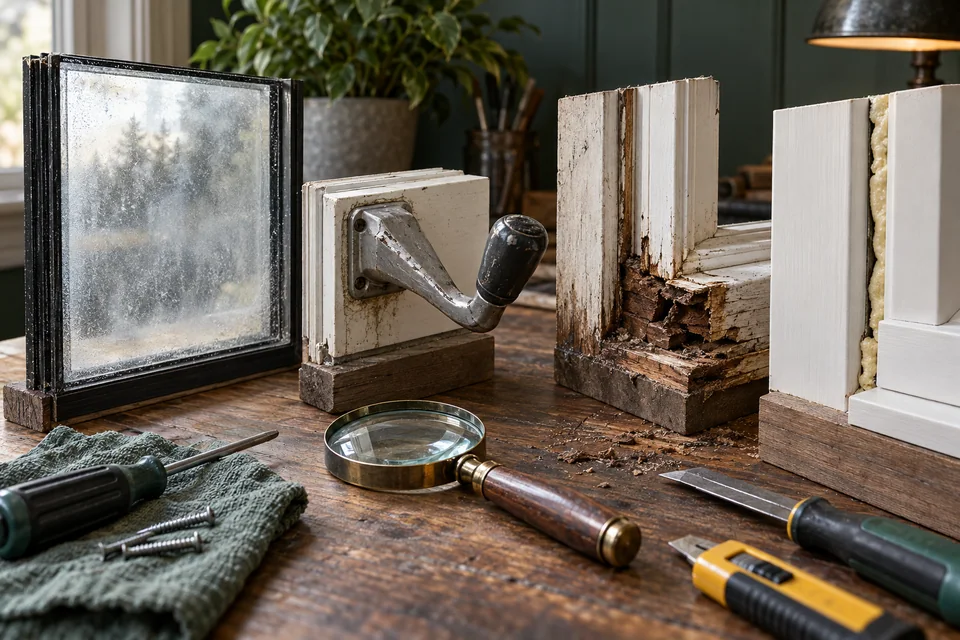
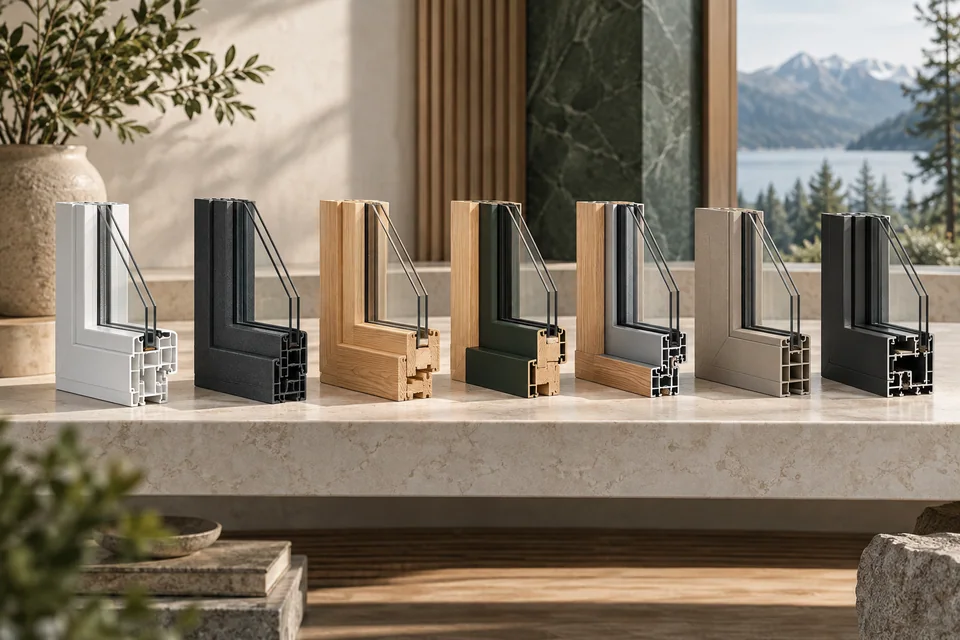
For an older or protected building, establish the window's heritage significance, legal protection and condition before ordering replacements. Record the existing profiles, glazing pattern, materials, operation and relationship to the wall. Compare repair and compatible upgrades with replacement using the same goals and scope. Local heritage approval and a conservation assessment may be needed; age alone neither makes a window unrepairable nor determines its legal status.
Canadian planning context. Technical examples from other regions are identified in the guide; approval and performance requirements must be checked for the actual building and jurisdiction. Original explanatory diagrams are not construction details.
- An inventory listing, a legal designation and a conservation recommendation are different things.
- Assess components individually rather than treating weathered paint as proof that the entire window must be discarded.
- Window character includes proportions, sightlines, reveal, muntins, glass appearance and operation, not just colour.
- Compare repair, storms or secondary glazing and replacement against the same comfort, maintenance and preservation goals.
- Obtain required approvals before removal or fabrication and plan for hazardous materials in older construction.
01 /Start with significance and status
An old window can carry information about the building's design, craft, use and changes over time. Some are original; others belong to a later period that has become significant in its own right. The first task is to understand that history rather than assume the earliest appearance is always the correct target. Collect historic photographs, drawings and any Statement of Significance or designation document. Note which elevations and features are identified.
Legal status requires its own check. A building's inclusion in an inventory does not automatically establish the same protection as a designation. Calgary, for example, distinguishes listed sites from designated resources and explains that designation can require Heritage Planning approval for changes to specified historic elements. This is a local example, not a rule for every municipality. Ask the relevant authority what applies to the property and proposed work.
| Question | Evidence | Decision |
|---|---|---|
| What is significant? | Statement, archival record and conservation assessment | Which features should be retained or matched? |
| What is protected? | Current designation, district rules or other legal instrument | Which approvals are required? |
| What is its condition? | Opening-by-opening component survey | What can be maintained, repaired or replaced? |
02 /Document the window as part of the facade
A replacement may fit the opening but alter the facade through thicker frames, different meeting rails, a flatter reveal or a changed glass pattern. Record the whole elevation before the close-up. Then record frame and sash proportions, muntin profiles, sill and head treatment, trim, opening method, hardware and glass appearance. A single photograph taken straight-on may hide depth and shadow; include an oblique view where safely accessible.
| Feature | What to capture | Why a near-match may differ |
|---|---|---|
| Opening and proportions | Width/height relationship and position | A smaller insert changes glass-to-wall proportions |
| Frame and sash | Sightline widths and section profiles | New frame depth changes shadows and apparent thickness |
| Muntins and glazing | Pattern, profile, location and glass appearance | Applied bars do not always read like divided lights |
| Reveal and trim | Depth, mouldings, sill and head | Capping may hide defining details |
| Operation | How it opens and intended ventilation | Changing to fixed glass alters use |
| Materials and finish | Wood, steel or other construction and colour evidence | A similar colour does not replicate texture or detail |
Give each opening a stable ID in the project workbook. Keep original images and a dated condition record. If a sample must be retained during a later approved intervention, agree how it is labelled, stored and handed over. Documentation should preserve evidence rather than become an excuse to remove repairable material.
03 /Assess components rather than appearances alone
A conservation assessment should distinguish frame, sash, sill, joints, glazing, putty or glazing seals, hardware, balances and finishes. Peeling paint, a broken cord and local wood deterioration have different implications. Identify the source of water exposure and adjacent wall conditions before assuming a product change solves the issue. Some components may be repairable while others need carefully matched replacement.
Canada's Standards and Guidelines for the Conservation of Historic Places emphasize minimal intervention and retention or repair of character-defining elements where feasible. Their window guidance calls for documentation and attention to the forms, materials and detailing that create significance. These are conservation principles; they do not by themselves determine the permit conditions for your property. The qualified assessor and authority must apply them to the actual building.
04 /Compare complete options fairly
Repair and replacement quotes often cover different outcomes. A repair proposal may restore operation and finish but omit a secondary glazing option. A replacement proposal may promise improved thermal performance but omit masonry restoration or heritage review. Compare them against the same project goals and include recurring care, access, disruption and documentation. Do not assume either option has a fixed universal service life or energy payback.
| Option | Potential purpose | Questions to resolve |
|---|---|---|
| Maintenance and localized repair | Retain sound material and restore function | Condition, finish compatibility and future care |
| Weatherization | Address identified air paths and operating fit | Appropriate details without trapping moisture |
| Storm window or secondary glazing | Improve performance while retaining the primary window | Appearance, ventilation, access and cavity moisture |
| Matched component replacement | Replace irreparable parts while retaining sound assembly | Profiles, material, fit and evidence |
| Complete replacement | Respond to a substantiated need where retention is unsuitable | Approval, appearance, performance and full wall connection |
U.S. National Park Service technical resources discuss repair assessment and compatible window upgrades. They are useful technical references, but U.S. preservation and tax-program rules do not apply automatically in Canada. Use them to ask better questions, then follow your property's local conservation and approval process.
05 /Treat comfort as a whole-building question
Cold discomfort may involve air leakage, cold glass, wall defects, room heating or how coverings restrict air circulation. Summer discomfort may involve orientation, shading and ventilation. A higher-performing glass package can be part of a solution, but it is not a complete energy model. Compare house-specific conditions and use rather than transferring a marketed energy-saving percentage to your building.
Secondary glazing and storms need their own moisture and access design. Ask how the cavity will be managed, how the primary window remains operable, how cleaning occurs and whether the appearance is acceptable. Do not seal every gap indiscriminately or add film without reviewing compatibility. The intervention should preserve the intended function and avoid concealing deterioration.
06 /Build the approval and procurement package
Ask the authority what it needs before paying for fabrication. A package may include a significance record, condition assessment, existing and proposed elevations or sections, material and finish samples, product details and reasons for the chosen option. Clearly identify retained, repaired and replaced components. A close colour match may be insufficient if the profiles, glass pattern or reveal change materially.
- Confirm the process
Identify the applicable authority, designation or district requirements and review stages.
- Present the condition evidence
Show what is sound, deteriorated or missing and how the assessment was made.
- Compare the options
Explain why the proposed treatment meets preservation and functional goals.
- Resolve details
Record profiles, materials, finish, glass appearance and wall connections.
- Obtain the required written approval
Match it to the exact proposal before removal or order release; re-review later substitutions.
Use the specification schedule to connect the approved design to the supplier's exact order. Keep the approval separate from a supplier quotation; neither automatically replaces the other. For a custom reproduction, discuss samples or mock-ups before multiplying an unconfirmed detail across the facade.
07 /Plan safe work around older materials
Older finishes and surrounding construction can contain hazardous materials. Health Canada's lead-based-paint guidance explains that disturbing old coatings can create exposure concerns. Have the appropriate parties identify the assessment and safe-work requirements before scraping, sanding, removal or demolition. This guide does not provide hazardous-material removal instructions or assume every old window contains the same materials.
Protect occupants, neighbouring surfaces and retained components through a defined work plan. Confirm who handles assessment, containment, waste and restoration. Temporary protection during conservation work should preserve both the building and the retained windows. A window removed for repair needs identification and agreed storage; losing the opening record can lead to a mismatched reinstallation.
08 /Keep the conservation record after completion
Record the treatment for each opening: retained components, repairs, matched replacements, coatings and added secondary systems. Keep before-and-after photos, approvals, supplier information and maintenance instructions. A future conservator should be able to distinguish original material from later work without dismantling the assembly or guessing from appearance.
The maintenance plan is part of the decision, not an afterthought. Assign routine inspection and care using the actual materials and manufacturer's or conservator's guidance. If a new concern develops, compare it with the condition history before proposing further removal. Continue with the acceptance guide for clear handover and unresolved items.
FAQQuestions people ask
Does an old house automatically have heritage restrictions?
No. Verify the property's actual status, local rules and any designation or district requirements.
Does peeling paint mean replacement is necessary?
No. Assess the components and causes. Finish deterioration, local damage and whole-assembly failure are different findings.
Can an insert preserve the original appearance?
It may change visible glass, profiles and reveal. Evaluate the actual proposed detail rather than assume it is visually equivalent.
Are U.S. preservation tax rules relevant in Canada?
They do not apply automatically. U.S. technical references can inform questions, while Canadian and local approvals govern the property.
Should I order a replica before approval?
Obtain the required review of the exact proposal first. Custom fabrication does not establish approval or a suitable match.
SOURCESSources and further reading
- Historic Places Canada — Standards and Guidelines for conservation
- Historic Places Canada — Window conservation guidance (PDF)
- City of Calgary — Heritage Planning (local example)
- City of Calgary — Municipal Historic Resource designation
- U.S. National Park Service — Repair of historic wooden windows (technical reference)
- Health Canada — Lead-based paint