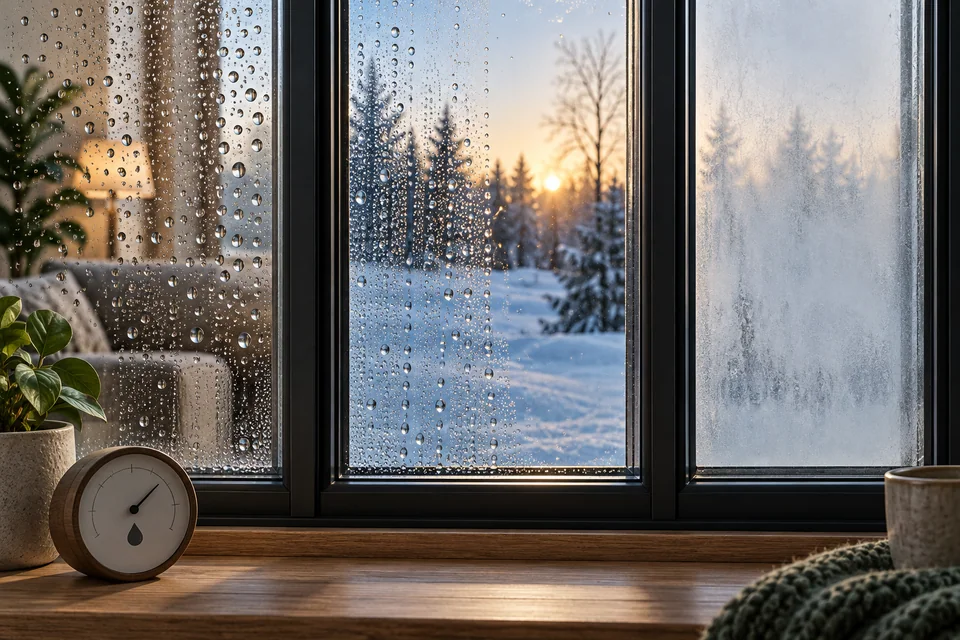
Interior coverings can change air movement and temperatures around a window. Closed heavy curtains or closely fitted blinds may leave the glass colder and allow moisture to collect. Record where the moisture appears and the room conditions, keep necessary airflow and operation clear, and address the moisture source or ventilation problem. Opening a covering can help investigate a pattern, but it does not diagnose every leak or establish a universal humidity setting.
Canadian planning context. Technical examples from other regions are identified in the guide; approval and performance requirements must be checked for the actual building and jurisdiction. Original explanatory diagrams are not construction details.
- Distinguish indoor surface droplets, exterior condensation and fog between panes before choosing a response.
- Observe the room and window together: coverings, heating outlets, occupancy, moisture sources and weather.
- Health Canada's general humidity guidance is not proof against condensation on every cold window.
- Window accessories must remain compatible with product instructions and required operation or escape paths.
- Ventilation choices depend on indoor and outdoor conditions; opening windows is not always the appropriate response.
01 /The window sits inside a room system
A covering can provide privacy, glare control and reduced unwanted heat gain while also changing conditions close to the glass. A tight cellular shade, long curtain and open roller blind behave differently. Furniture, deep sills, radiators and supply outlets also affect air movement. That is why a newly installed shade may reveal a moisture pattern even when the window product has not changed.
Think in layers: outdoor weather, glass and frame temperatures, the pocket of air behind the covering, room temperature and humidity, and the building's ventilation. A rating measured under standardized conditions does not describe every one of these layers. A colder surface can collect moisture at a room humidity that causes no visible problem elsewhere. The condensation guide explains the different surfaces and common observations.
02 /Locate the moisture before responding
| Location | Useful description | Next question |
|---|---|---|
| Indoor glass | Droplets on the room-facing surface, especially after a cold night | What are room humidity, surface temperature and air movement? |
| Indoor frame or sill | Wetness or recurring staining at a specific joint | Is it condensation, a leak or another moisture source? |
| Between panes | Persistent fog apparently inside the sealed glazing space | Can a glazier or supplier assess the glazing unit? |
| Exterior glass | Outside droplets that change with weather | Is this an exterior-surface pattern rather than water entering? |
| Head or adjacent wall | Water appears after wind-driven rain | Does the wall/window connection need investigation? |
Take an overview and a close-up, record the date and conditions, and note whether the covering was open or closed. Do not assume every wet sill proves a failed sealed unit. Conversely, do not dismiss active rainwater entry as ordinary humidity. If water is damaging finishes or the source is unclear, arrange an appropriate assessment.
03 /Use a simple observation log
A few consistent observations can help a specialist investigate. Record room temperature and relative humidity with the instrument location and time, outdoor conditions, covering position, which openings are affected and when moisture appears or clears. Note cooking, showers, drying clothes, humidifier use, recent occupancy changes or altered heating patterns. One undated humidity reading taken across the house may not describe the air beside the glass.
| Field | Example entry |
|---|---|
| Opening | W03, bedroom, north-facing wall |
| Time | Morning before covering opened |
| Covering | Close-fitting blind fully down overnight |
| Room reading | Temperature/RH and instrument location |
| Surface | Droplets at inside lower glass edge; photo saved |
| Weather | Outdoor temperature and whether rain/wind occurred |
| Change | Pattern observed after covering opened; no diagnosis inferred |
Change one ordinary, safe condition at a time if investigating a non-urgent pattern, such as opening the blind during the observation period. Do not switch off required ventilation, overheat the room or disable safety devices to create a test. Keep the observations rather than promise a cure from a single adjustment.
04 /Humidity guidance needs climate and surface context
Health Canada recommends maintaining relative humidity generally between 30% and 50% and advises keeping coverings open so warm air can reach windows, with heating outlets clear. It also notes that heavy curtains or blinds can trap cold and moisture. These are general household measures, not a condensation-proof setting for every product in a Canadian cold snap. Cold glass and frame edges can still become wet at lower room humidity.
NRCan's condensation guidance likewise identifies coverings, deep sills and nearby furniture as factors that can obstruct air movement. Use the actual pattern and, where necessary, a professional assessment to decide whether the main issue is moisture generation, ventilation, a cold assembly or a leak. The site does not prescribe a universal winter RH target or treat the absence of visible droplets as proof of healthy indoor air.
05 /Ventilation is broader than opening a sash
Bathroom and kitchen exhaust, a heat- or energy-recovery ventilator and other ventilation systems have different roles. Ask the responsible service provider how the installed system should operate and whether it is maintained and balanced. A tighter replacement window may change incidental air leakage without providing a deliberate ventilation strategy. Do not depend on old drafts as a healthy-air plan.
Health Canada's ventilation guidance describes how increased ventilation can reduce winter indoor moisture in some situations, while introducing warm humid outdoor air can increase moisture under other conditions. Its indoor-air guidance also advises reducing outdoor-air entry during high outdoor pollution. Therefore 'open the windows whenever condensation appears' is not a universal recommendation. Outdoor humidity, temperature, smoke or pollution, security and the building's systems all matter.
In a condominium, coordinate changes to shared ventilation or controls with the responsible building party. A resident should report symptoms and ask for assessment rather than block an outlet, alter a fan or drill a new vent. For a house, record system type and maintenance history with the window inventory when comfort and moisture are project goals.
06 /Choose coverings and attachments with the product in mind
Ask how the covering will mount, whether fasteners penetrate the frame, whether it obstructs handles or screens and how it will be removed for cleaning and service. A window product may have restrictions on modification or applied films. Obtain the actual manufacturer's position for your series rather than assume all drilling or film automatically has the same warranty effect.
| Choice | Question | Owner record |
|---|---|---|
| Inside-mounted blind | Will the mount affect frame, operation or nearby air movement? | Mounting location and maker guidance |
| Heavy curtain | Does it cover heating outlets or create a tight cold pocket? | Use and clearance observations |
| Film | Is it compatible with this glass and product? | Written supplier/manufacturer confirmation |
| Motorized shade | How are power, controls and safe maintenance handled? | Installer and operating instructions |
| Security or child-safety accessory | Is it compatible with required operation and escape? | Approved device and instructions |
Corded coverings present separate child-safety considerations; choose and use products in accordance with applicable Canadian requirements and manufacturer instructions. Do not obstruct a required escape opening or defeat an opening-control device to accommodate a blind. Product compatibility and room safety belong in the same planning discussion.
07 /Address persistent dampness and mould appropriately
Repeated dampness should be investigated and corrected rather than concealed by a new covering or painted trim. Health Canada identifies indoor mould as a potential health concern and emphasizes moisture control. If mould or water damage is present, consult its current guidance and arrange suitable help for the extent and circumstances. This guide does not diagnose health symptoms or provide a universal mould-removal procedure.
Keep a record of the affected material, extent, dates and moisture observations. In rented housing, notify the owner or appropriate management party. Avoid simply enclosing a damp sill with decorative trim. A repaired window or new covering will not resolve an unrelated wall, plumbing or ventilation problem. Continue with the warranty-evidence guide if the product is under review.
08 /Plan the room before approving the window order
Include coverings, furniture, heating outlets and operating access when choosing a window. A tall handle behind a permanent desk, a tilt-turn sash blocked by a blind or a new deeper sill that prevents airflow may reduce usability. Mock up the movement and reach safely before ordering where practical. The product's ordinary cleaning and maintenance access should remain possible.
Record comfort goals in the specification schedule: glare, privacy, summer heat, cold surfaces and operation are different goals. The right solution may combine glass selection, compatible shading and ventilation assessment. Preserve that record after installation so later room changes can be compared with the original design assumptions.
FAQQuestions people ask
Can blinds cause condensation?
They can contribute by changing air movement and conditions near cold glass. Record the pattern and investigate other moisture or leak causes rather than assigning one universal cause.
Is 30% to 50% RH safe for every window?
It is Health Canada's general household range, not proof against condensation on every cold surface. Climate, local air movement and product temperatures matter.
Should I open windows during wildfire smoke?
Do not use a generic condensation rule. Follow current outdoor-air and health guidance and the appropriate building ventilation strategy.
Can I drill blinds into the frame?
Confirm the exact product's mounting and modification requirements first. Compatibility and warranty effects vary.
Does new glass fix all moisture problems?
No. Ventilation, indoor moisture, wall leaks and room conditions may require separate assessment.